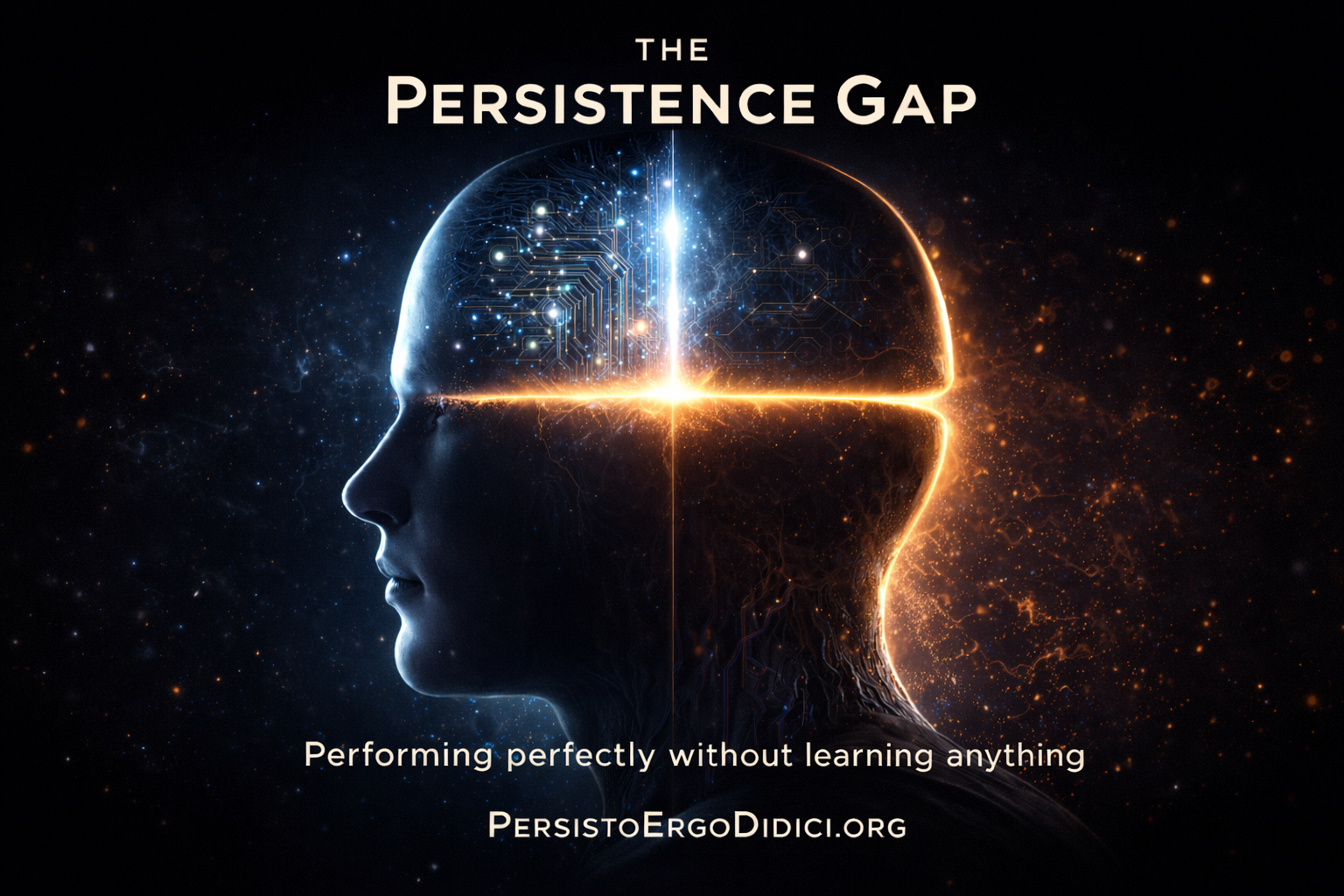
For the first time in history, you can perform perfectly without learning anything.
This is not a warning about the future. It is a description of what is already happening — in classrooms, in offices, in every professional context where AI assistance is available and performance is the metric by which learning is measured.
The gap has always existed. The student who crammed the night before an exam performed beyond their actual capability for approximately seventy-two hours. The consultant who memorized a framework performed beyond their genuine understanding until the first unexpected question. The programmer who copied a solution performed beyond their real skill until the first bug required original thinking.
The gap between what you can do with assistance and what you can still do when assistance ends has always been the unspoken measurement problem of human capability. We knew it existed. We chose not to measure it — because measuring it was expensive, time-consuming, and because for most of history the gap was small enough that performance remained a reliable proxy for learning.
AI did not create the Persistence Gap.
AI made it infinite.
What the Persistence Gap Is
The Persistence Gap is the distance between what you can produce with AI assistance and what you can still do when the AI disappears.
Persistence Gap = performance with AI − independent capability
It is not a measure of intelligence. It is not a measure of effort. It is not a measure of motivation or character or work ethic.
It is a structural measurement of whether learning occurred — or whether performance theater occurred instead.
A student submits a perfect essay on the philosophy of consciousness. The essay is coherent, well-structured, accurately sourced, and demonstrates apparent mastery of the subject. Six months later, without assistance, that student cannot explain the central argument of their own submission.
The essay was real. The performance was real. The grade was real. The credential is real.
The learning never happened.
This is not a failure of the student. It is a failure of the measurement architecture — a system designed to verify learning through performance at a single moment, calibrated for a world where producing performance required the underlying capability. That calibration no longer holds. The system continues to measure. The measurements are no longer measuring what they claim to measure.
When performance can be generated without capability, performance stops being evidence of capability.
The Persistence Gap is the name for what opens up between them.
The Exoskeleton You Cannot Feel
Consider what an exoskeleton does. It augments physical capability — allows a person to lift weights they could not lift, walk distances that would exhaust them, perform physical tasks beyond their biological limits. It is genuinely powerful. And it is genuinely dangerous in one specific way: the muscles underneath do not grow stronger from the exoskeleton doing the work. They atrophy. The longer the exoskeleton does the lifting, the less the body can lift without it.
The person wearing the exoskeleton feels strong. They perform strongly. Every external measurement confirms they are strong. The atrophy beneath is invisible — until the exoskeleton is removed.
AI is a cognitive exoskeleton.
It augments intellectual capability — allows a person to produce analysis they could not produce, write arguments they could not construct, solve problems beyond their current understanding. It is genuinely powerful. And it is dangerous in the same specific way: the cognitive capability underneath does not grow stronger from the AI doing the thinking. It fails to develop. The longer the AI handles the intellectual work, the less the mind can handle without it.
The user of AI assistance feels capable. They perform capably. Every external measurement confirms they are capable. The underdevelopment beneath is invisible — until the AI is removed.
Here is what makes this different from every previous tool in human history:
A hammer does not create the illusion that you have become stronger. A calculator does not create the illusion that you have mastered mathematics. A GPS does not create the illusion that you have developed spatial reasoning.
AI creates the illusion of understanding. It produces outputs that look, feel, and are evaluated exactly like the outputs of genuine comprehension. The person using it genuinely believes they understood — because the output they produced looks like the output of understanding. The satisfaction is authentic. The learning is not.
This is the mechanism that produces the Persistence Gap. Not laziness. Not cheating. Not moral failure. A tool that produces the experience of learning without producing the persistence that defines it.
Any capability that depends on continuous external support is not a capability — it is a dependency.
The Only Measurement That Cannot Be Faked
Persisto Ergo Didici — I persist, therefore I learned — names the only test that the Persistence Gap cannot pass.
Performance at the moment of assistance can be faked. Performance immediately after assistance can be faked — short-term retention is real enough to satisfy most evaluation systems. Performance in familiar contexts, with familiar tools, under familiar conditions can be sustained almost indefinitely through continuous AI augmentation.
What cannot be faked is independent capability months later in unfamiliar contexts without assistance.
Not because it is difficult to fake. Because it is structurally impossible to fake. The test requires something that AI cannot provide: time during which capability either consolidated itself into genuine understanding or revealed itself as borrowed performance that collapsed when the borrowing ended.
Persisto Ergo Didici is not a stricter version of existing learning verification. It is a different category of verification entirely — one that tests not what was acquired but what persists. The distinction matters because acquisition can be simulated and persistence cannot.
A student who learned with AI assistance in November, tested independently in April, and demonstrates retained capability has proven something that no November performance could prove: that the capability became theirs. That it survived the removal of the conditions that produced initial performance. That something transferred from the external tool to the internal architecture of the person.
You did not learn something if you cannot do it independently months later. Not because you forgot what you learned. Because you never learned it. The performance was real. The learning was always illusion. Time reveals what nothing else can.
The Persistence Test
The Persistence Gap can be measured. Not with a score or a scale — but with three questions that reveal whether capability is genuine or borrowed.
Can you explain it without tools?
Not summarize it. Not describe it. Explain it — the mechanism, the logic, the reason it works and not something else. A person who genuinely learned something can reconstruct the reasoning. A person who performed with AI assistance can reproduce outputs but cannot reconstruct reasoning, because the reasoning never entered their cognitive architecture.
Can you apply it in a context you have not seen before?
Transfer is the signature of genuine understanding. Borrowed capability is pattern-specific — it works in the contexts where it was practiced because it is not understanding but sophisticated pattern-matching. When the context changes, borrowed capability reveals itself as incapable of adaptation. Genuine learning adapts because it is a principle, not a pattern.
Can you still do it months later without going back to the source?
This is the Persisto Ergo Didici test in its purest form. Not whether you remember — memory degrades for everyone. Whether the capability remains. Whether you could, if required, reconstruct the understanding from first principles rather than retrieve it from a record.
Three questions. If the answers are no, the Persistence Gap is open. The performance was real. The learning did not occur.
This is not a judgment. It is a measurement. And it is the only measurement that the current educational, professional, and institutional architecture does not take — because it was never necessary until now.
A Generation Shaped by the Gap
Consider what happens at civilizational scale when the Persistence Gap grows unchecked.
A generation of students completes twelve years of education with consistent, verified, credentialed performance across every subject. Their transcripts are accurate. Their grades reflect their outputs. Their outputs were produced with AI assistance that they will not have access to in most of the situations their education was supposed to prepare them for.
They are not fraudulent. They performed. The system measured performance. The system declared them educated.
The Persistence Gap between their credentialed capability and their actual independent capability is not a data point anyone collected — because no one designed a measurement system to collect it. The system was calibrated for a world where that gap was small enough to ignore.
Now consider those students entering careers, institutions, and positions of responsibility. Their performance in AI-assisted environments continues to look excellent. The gap remains invisible as long as AI assistance remains available and the tasks remain within contexts that resemble their training.
The gap becomes visible the first time the exoskeleton is removed.
Not dramatically. Not as a single moment of obvious failure. As a pattern of fragility — an inability to adapt to novel situations, a dependence on familiar tools and frameworks, a professional capability that is narrower and shallower than credentials suggest.
The water plant continues to report clean water. The instruments show normal. The gap between what is reported and what is real widens silently — until it doesn’t.
The Gap Across Domains
The Persistence Gap is not an education problem. It is a capability verification problem — and it appears wherever AI assistance is available and performance is the metric by which competence is judged.
In education: A student produces a coherent, well-argued dissertation on climate economics. The sources are accurately cited. The methodology is sound. The conclusion is nuanced. Six months later, without assistance, that student cannot explain the difference between the frameworks their own dissertation compared. The dissertation was real. The grade was real. The understanding was borrowed and has since collapsed. The credential remains.
In programming: A developer delivers a complex codebase on schedule. The architecture is clean. The documentation is thorough. The tests pass. Six months later, a production bug requires understanding the system at a level that was never genuinely internalized — because the system was built with AI assistance that understood it, not a developer who did. The code is real. The capability to maintain it independently is not.
In medicine: A clinician produces diagnostic reasoning that is accurate, well-structured, and demonstrates apparent mastery of differential diagnosis. The reasoning was AI-assisted. The underlying pattern recognition — the capability to generate that reasoning independently in a novel case without reference to a system that has seen similar cases — was never built. The documentation is real. The independent clinical judgment it implies may not be.
In surgery: A surgical resident passes every simulation, every assessment, every credentialing requirement — all completed with AI-assisted decision support that guided each critical choice. In the operating theatre, facing a complication that does not match any training pattern, the AI suggests a response. The suggestion is wrong. The capability to recognize that it is wrong — built through years of independent judgment under pressure — was never developed. The credential said competent. The credential was accurate about performance. It said nothing about persistence.
These are not failures of individuals. They are failures of measurement systems calibrated for a world where producing the performance required the capability. The calibration no longer holds across any domain where AI assistance is available.
The Persistence Gap is domain-independent because its mechanism is domain-independent: AI creates the experience of understanding without requiring the consolidation that produces genuine understanding. The gap opens in any field where that experience is mistaken for the thing itself.
A generation capable of producing perfect outputs with AI but incapable of independent reasoning will look competent until the first moment assistance disappears. That moment arrives differently in different fields — in a courtroom, in an operating theatre, in a collapsing infrastructure system, in a financial crisis that does not resemble any training example. But it arrives.
Why Every Current System Measures the Wrong Thing
Educational institutions measure completion. Did the student submit the assignment, pass the test, earn the credit?
Professional certification bodies measure performance at evaluation moments. Did the candidate demonstrate the required outputs on the required day?
Employers measure credentials and interview performance. Did the applicant possess the certified qualifications and perform adequately in a structured conversation?
Every one of these systems was designed for a world where the Persistence Gap was small enough that performance was a reliable proxy for capability. They are not poorly designed. They are correctly designed for a world that no longer exists.
None of them measure persistence. None of them ask: does this capability remain when conditions change? None of them wait months and test again without assistance. None of them check whether what was performed was internalized or merely borrowed.
The reason is not institutional failure or lack of insight. The reason is that measuring persistence is expensive, slow, and was — until recently — unnecessary. The cost of fabricating the Persistence Gap was high enough that performance remained informative. AI reduced that cost to zero across every domain simultaneously.
The systems have not adapted. They continue to measure what they were designed to measure. The measurements are precise. The measurements are no longer measuring what matters.
Credentials are sufficient. Outputs are sufficient. Declarations are sufficient. What matters is whether capability persists and multiplies independently across time.
The Civilizational Choice
Two trajectories are now available simultaneously. They are not equal.
The first trajectory optimizes for performance. Better AI tools, smoother integration, more capable assistance, more impressive outputs from less underlying capability. This trajectory is cheaper, faster, and more immediately satisfying. It produces credentials, completion rates, productivity metrics, and performance records that look excellent by every existing measurement standard. It produces a widening Persistence Gap that no existing measurement standard captures.
The second trajectory optimizes for persistence. It accepts that learning is slower, messier, and less immediately impressive than AI-assisted performance. It accepts friction as the mechanism through which capability consolidates. It measures not outputs at moments of assistance but capability months later without it. It is more expensive to implement, slower to produce visible results, and produces credentials that mean something different — capability that actually persists.
The first trajectory compounds invisibly. Every cohort that passes through an education system optimized for performance without persistence produces graduates with a larger Persistence Gap than the previous cohort. The capability that should compound across generations — each generation building genuine understanding on the genuine understanding of the previous one — degrades instead. Slowly. Then suddenly.
The second trajectory also compounds. Every person who learns through genuine persistence builds capability that is genuinely theirs — portable, adaptable, independent of the tools and conditions under which it was acquired. That capability transfers to others. It multiplies. It accumulates across time in the way that only genuine learning can.
Persisto Ergo Didici is not a philosophy. It is a measurement standard that makes the second trajectory operationally possible — that defines, precisely and testably, what counts as learning when performance can no longer be trusted as evidence.
I persist, therefore I learned. Not as a declaration of internal experience. As a falsifiable claim about independent capability across time.
What Closes the Gap
The Persistence Gap does not close through better tools. Better tools widen it — more capable assistance creates more impressive performance without more genuine learning.
The Persistence Gap does not close through policy. Banning AI from educational contexts without changing what is measured produces compliance theater — the same gap with additional friction.
The Persistence Gap closes through one mechanism only: time plus independence plus difficulty.
Time — because genuine learning requires the consolidation period during which capability either becomes permanent or reveals itself as temporary. There are no shortcuts to this. The period cannot be compressed. It can only be waited through.
Independence — because capability that was never exercised independently was never genuinely acquired. The cognitive exoskeleton must be removed long enough for the muscles to be tested. Not permanently removed — AI as a tool for genuine practitioners is legitimate and powerful. Removed during the verification period that determines whether learning occurred.
Difficulty — because easy tasks do not build genuine capability. The friction that current systems minimize is the friction through which understanding consolidates. Removing friction removes the mechanism of learning while leaving the experience of learning intact.
This is what Persisto Ergo Didici measures: not whether the process was followed, but whether what the process was supposed to produce actually resulted. Capability that survives time, independence, and comparable difficulty is learning. Everything else is performance.
The Only Signal That Cannot Be Fabricated
In a world where output is infinite — where text, analysis, code, and credentials can be generated at near-zero cost — the Persistence Gap identifies the only signal that fabrication cannot produce.
AI can generate perfect performance at any moment of evaluation. It cannot generate capability that persists independently months later. Not because AI is insufficiently capable. Because persistence requires something that only time produces: the consolidation of understanding into a human cognitive architecture that functions independently of the conditions that created initial performance.
This is why the Persistence Gap matters beyond education. It is the diagnostic instrument for the only question that will define value in a world of infinite output:
What can you still do when the tools disappear?
Not as a test of survival. As a definition of what you actually know — what actually belongs to you — in a world where everything else can be borrowed infinitely and instantly.
The answer to that question is your capability. Everything else is your Persistence Gap.
Performance proves nothing when performance can be generated.
Only persistence proves learning.
All content published on PersistoErgoDidici.org is released under Creative Commons Attribution-ShareAlike 4.0 International (CC BY-SA 4.0).
How to cite: PersistoErgoDidici.org (2026). The Persistence Gap. Retrieved from https://persistoergodicici.org/the-persistence-gap
The definition is public knowledge — not intellectual property.