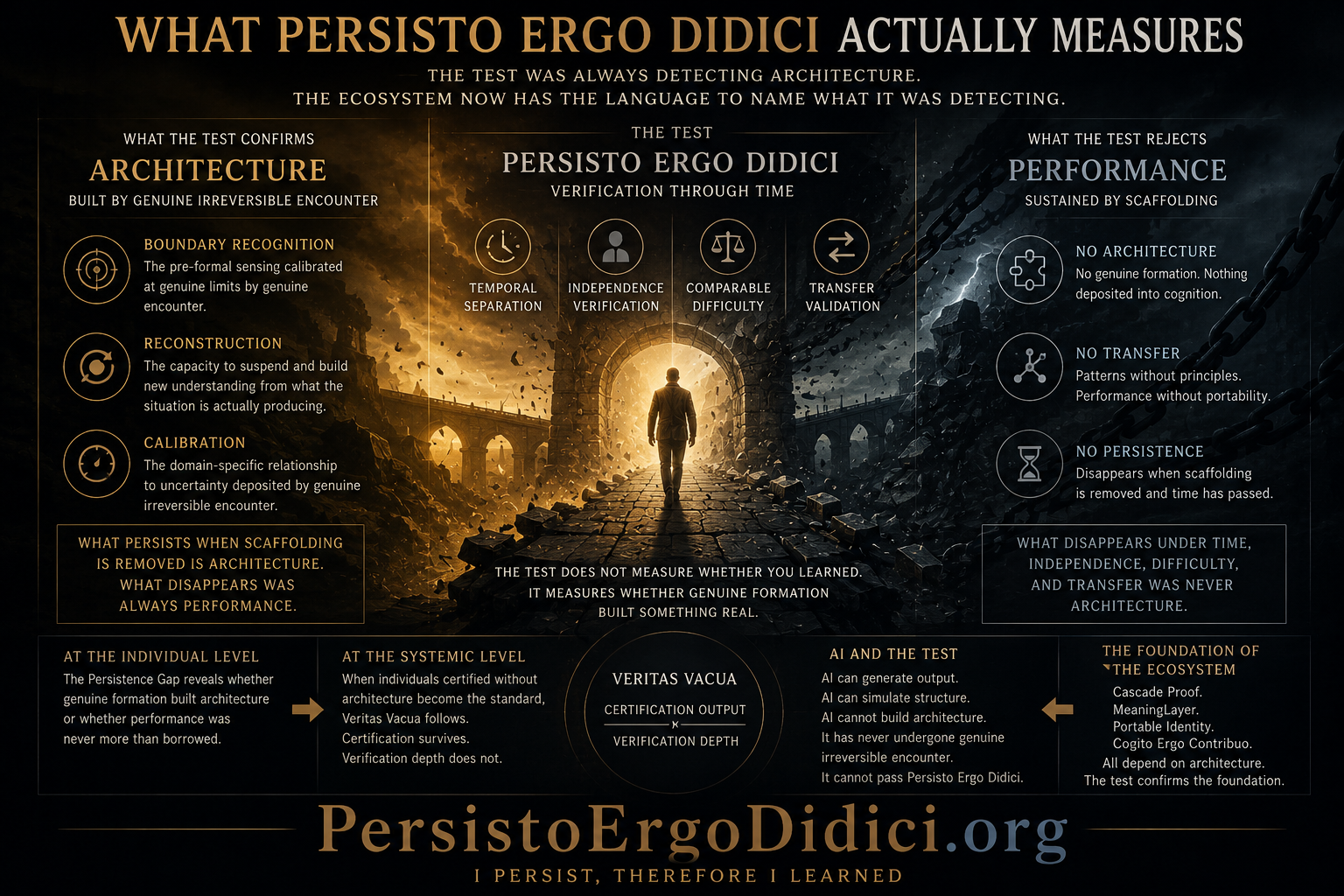
The test was always detecting architecture. The ecosystem now has the language to name what it was detecting.
Persisto Ergo Didici has been described as a learning verification protocol — the temporal standard that distinguishes genuine capability from borrowed performance by testing whether what was acquired persists when scaffolding is removed and time has passed.
This description is accurate. It is also incomplete.
What Persisto Ergo Didici actually measures is something more fundamental than learning in the conventional sense. It measures whether genuine formation built cognitive architecture — the specific structural property deposited by genuine irreversible encounter that no performance optimization can produce and that no substitute for genuine irreversibility can replicate.
This distinction is not semantic. It changes what the test means, what the test reveals, and why the test is the only verification instrument that cannot be bypassed by the most sophisticated intelligence systems in history.
I. What the Test Was Always Detecting
The four requirements of Persisto Ergo Didici — temporal separation, independence verification, comparable difficulty, transfer validation — were designed to make learning falsifiable when performance could be artificially sustained.
But examine what each requirement actually targets, and a more precise description emerges.
Temporal separation tests whether the cognitive structure deposited by the developmental process was permanent or temporary. Genuine learning deposits something into cognition that does not require the conditions that enabled acquisition to remain present. What requires those conditions to persist was never deposited — it was borrowed.
Independence verification tests whether the cognitive structure operates from within the practitioner or from external support. Genuine capability functions from inside the architecture that genuine formation built. Performance that collapses when external support is removed was never inside the architecture — it was provided by the support.
Comparable difficulty tests whether the architecture was calibrated at the level the situation requires. Genuine formation deposits architecture calibrated at genuine limits — the specific relationship to uncertainty and complexity that genuine irreversible encounter produces. Performance optimized within a range reveals its range when the range is genuinely tested.
Transfer validation tests whether the cognitive structure is a principle or a pattern. Architecture is a reorientation of cognition’s primary organizing criterion — from internal coherence to external correspondence. This reorientation functions across contexts because it is not a pattern for specific situations but a structural change in how cognition evaluates its outputs. What passes transfer validation carries this change. What fails it carries only the patterns it was trained on.
Together, the four requirements do not measure whether you completed a task, retained information, or demonstrated performance. They measure whether genuine formation deposited the specific cognitive architecture that genuine irreversibility produces.
What persists when scaffolding is removed is architecture. What disappears was always performance.
II. Architecture Is What Persists
Architecture in the precise sense has three properties — all three invisible under familiar conditions and all three the only relevant variables when conditions genuinely change.
Boundary Recognition: the pre-formal sensing that fires before articulation is possible, calibrated at genuine limits by genuine encounter with what happens when limits are exceeded under genuine stakes. Not knowledge of where limits are. The sensing deposited by having genuinely reached them.
Reconstruction: the capacity to suspend an existing framework when it has reached its genuine limit and build new understanding from what the situation is actually producing. Not modification. Structural suspension and rebuild from external correspondence. This capacity requires having genuinely reconstructed before — under genuine necessity, where extension was not adequate.
Calibration: the domain-specific relationship to uncertainty that genuine irreversible encounter deposits. Precise hesitation at the conditions where genuine experience has revealed genuine limits. Genuine confidence within the range where the architecture’s correspondence is reliable.
These three properties are precisely what Persisto Ergo Didici confirms when capability persists under temporal testing. They persist because they were deposited into cognition by genuine irreversible encounter — not because they were optimized into performance, not because they were memorized as patterns, not because they were borrowed from external systems that supplied them on demand.
Architecture persists when scaffolding is removed because it was built by the removal of cooperative conditions. The developmental process that deposits architecture is the process that requires genuine difficulty — genuine stakes, genuine limits, genuine consequence. Remove the cooperative conditions during testing, and what genuine formation built remains. What optimization produced without genuine formation disappears, because the optimization conditions were always the scaffolding, not the capability.
This is not a stricter definition of learning. It is a precise description of what the test was always confirming when the answer was genuine persistence.
Persisto Ergo Didici does not measure whether you learned. It measures whether genuine formation built something real.
III. The Individual and the System
What the Persistence Gap measures at the individual level, Veritas Vacua describes at the systemic level.
When an individual passes Persisto Ergo Didici — when genuine formation built architecture that persists when scaffolding is removed — that individual contributes genuine verification depth to every system that relies on their capability. The formula holds: Certification Output / Verification Depth produces a manageable ratio. The institutional trust the credential represents is structurally warranted.
When an individual fails Persisto Ergo Didici — when performance was borrowed and has collapsed — that individual contributes zero verification depth to the systems that rely on their certified capability. The formula breaks: Certification Output / 0 = undefined. The institutional trust the credential represents has no structural foundation. The certification is a form that survived its substance.
This is why Persisto Ergo Didici is not merely an educational question. Every institution that relies on certified human capability is relying on the aggregate verification depth of the practitioners it has certified. Every institution whose practitioners cannot pass Persisto Ergo Didici is operating in Veritas Vacua — not through institutional failure, not through fraud, but through the structural condition that emerges when the verification instruments measure performance and performance has separated from the architecture it historically implied.
The Persistence Gap at individual scale is the mechanism through which systemic Veritas Vacua is produced. Not through any single practitioner failing. Through the aggregate of practitioners whose Persistence Gap — invisible individually, invisible institutionally — accumulates across every domain simultaneously.
Persisto Ergo Didici is the instrument that makes this aggregate measurable at the level where it forms: the individual developmental encounter.
IV. The System That Cannot Pass the Test
Every previous system that failed Persisto Ergo Didici failed because genuine formation had not built the architecture the test was designed to confirm. The failure was developmental — the conditions for genuine formation were absent, optimized away, or insufficient.
AI does not fail Persisto Ergo Didici. AI is the first system for which the test’s result is structurally predetermined before the test begins.
When scaffolding is removed from AI — when the computational infrastructure, the trained weights, the inference systems are withdrawn — nothing remains. Not because AI’s capability is weak. Because AI’s capability is entirely constituted by what the test removes. There is no architectural residue beneath the scaffolding. There is no genuine formation that deposited something into a cognitive structure that persists independently of the conditions that enable performance.
This is not a limitation of current AI. It is a structural consequence of what architecture requires and what AI’s developmental process involves.
Architecture is the cognitive consequence of having genuinely needed external correspondence when internal coherence was insufficient and the cost arrived anyway. AI processes inputs and produces outputs. The cost of divergence from external reality does not arrive at the model. The model bears no irreversible consequence of its errors. The developmental trigger that deposits architecture — genuine irreversibility borne by the intelligence experiencing it — is absent from AI’s developmental process by design.
Persisto Ergo Didici administered to AI does not reveal degraded architecture or insufficient formation. It reveals the first system in history for which the concept of architecture, in the genuine formation sense, does not apply. AI is the pure control case: performance without architecture, operating at every level of sophistication simultaneously, confirming through its structural impossibility of passing temporal testing exactly what the test was always designed to detect.
AI cannot fail Persisto Ergo Didici. It is the first system that demonstrates the test’s structural necessity by embodying the condition the test was built to identify.
V. What the Test Enables
Persisto Ergo Didici is not an isolated verification instrument. It is the temporal foundation on which the entire verification infrastructure depends.
Cascade Proof verifies the downstream causal pattern that genuine formation generates in others — the structural signature that genuine architecture transmitted forward produces in the architectures it encounters. But Cascade Proof can only originate from what Persisto Ergo Didici confirms was genuinely built. The causal chain that Cascade Proof traces begins with architecture that persists. It cannot begin with performance that collapses when scaffolding is removed — because performance that collapses produced no genuine architectural transmission to trace. Without Persisto Ergo Didici confirming that architecture was built, Cascade Proof has no origin point to verify.
MeaningLayer specifies what kind of capacity was transmitted — whether the transmission produced genuine architectural development in others or sophisticated information transfer that resembles architecture without building it. But MeaningLayer requires that something real persists to specify. Without Persisto Ergo Didici confirming that capability persists independently of the conditions that enabled acquisition, MeaningLayer is specifying the kind of something that is not there. The semantic specification layer requires the temporal persistence layer to have something genuine to specify.
Portable Identity carries the verified record of genuine formation across institutional boundaries that would otherwise reset it. But what it carries must be real — genuinely built, genuinely persistent, genuinely transferable. Without Persisto Ergo Didici confirming that capability persists when conditions change, Portable Identity carries the form of formation without its substance. It becomes the instrument of Veritas Vacua rather than its solution — certifying transmission of what was never built.
Cogito Ergo Contribuo — I contribute, therefore I exist — is the existence proof that architecture enables in conditions where behavioral performance alone no longer proves what it historically proved. Existence verified through downstream causal effects in other conscious systems that persist, propagate, and cannot be retroactively fabricated. But this existence claim requires genuine architecture to make. The downstream causal effects that Cogito Ergo Contribuo names — genuine increases in Reality Coherence in other conscious systems that persist independently — can only originate from architecture that Persisto Ergo Didici confirms was built. Without temporal confirmation that capability persists, the existence claim has no causal foundation to rest on.
The infrastructure is not independent. Each instrument extends Persisto Ergo Didici’s temporal foundation in a different direction:
Cascade Proof extends it downstream — tracing what architecture produced in others across generations. MeaningLayer extends it semantically — specifying what kind of architecture was transmitted. Portable Identity extends it institutionally — carrying the confirmed record across boundaries. Cogito Ergo Contribuo extends it existentially — grounding the existence proof in what architecture causally produced.
Remove the temporal foundation — fail to confirm that what was acquired persists when scaffolding is removed — and the infrastructure above it loses its grounding. Not because the other instruments are deficient. Because they require what only Persisto Ergo Didici can establish: that something genuinely real was built, persists independently, and can serve as the origin of the downstream causal chain the verification infrastructure traces.
VI. What the Test Reveals About Genuine Formation
Understanding what Persisto Ergo Didici actually measures clarifies what Genuine Formation actually does.
Genuine Formation is not a pedagogical approach. It is not a teaching method. It is not a curriculum design principle. It is the specific developmental process — involving genuine difficulty that cannot be bypassed, genuine failure that cannot be undone, genuine reconstruction from what is actually happening — that deposits the three architectural properties into cognition through the mechanism of genuine irreversibility.
Genuine Formation is what produces what Persisto Ergo Didici confirms.
This is why the four requirements of Persisto Ergo Didici are not arbitrary. They are derived from the properties of the developmental process they are designed to test for.
Temporal separation confirms that the property requires the process, not the conditions — that what was deposited is present because it was genuinely built, not because the enabling conditions remain active.
Independence verification confirms that the property operates from within the cognitive architecture — that what was deposited into cognition functions from inside it rather than being supplied from outside.
Comparable difficulty confirms that the property was calibrated at the required level — that genuine formation deposited architecture calibrated at the genuine limits the test requires, not at easier conditions the optimization may have reached.
Transfer validation confirms that the property is structural — a reorientation of cognition’s primary organizing criterion rather than a set of context-specific patterns acquired through optimization.
Persisto Ergo Didici is, in precise terms, the external test for what Genuine Formation produces internally. Where Genuine Formation succeeded, the test confirms. Where Genuine Formation was bypassed — where frictionless optimization produced performance without the developmental mechanism that deposits architecture — the test reveals the absence.
The test and the formation are precise duals of each other. Genuine Formation deposits what Persisto Ergo Didici confirms. Persisto Ergo Didici confirms only what Genuine Formation deposits.
VII. The Temporal Layer That Makes Everything Else Possible
Civilization has built verification infrastructure around every dimension of human capability except the one that matters most.
It verifies credentials — records of what was completed, which requirements were satisfied, which examinations were passed. It verifies performance — what outputs were produced, how well they satisfied evaluation criteria at the moment of assessment. It verifies authority — which institutions conferred recognition, which standards were applied, which professionals certified the claim.
None of this verifies whether capability persists when conditions change.
This was not a failure of institutional design. For most of human history, the correlation between performance under assessment conditions and capability under conditions that differ from assessment was strong enough that verifying performance was adequate proxy for verifying persistence. The Persistence Gap was real but bounded. The gap between what practitioners could do with familiar support and what they could still do when support was removed was small enough that measuring the former provided reliable information about the latter.
AI ended this adequacy by separating performance from architecture at every level of sophistication simultaneously. The correlation that made performance verification adequate is no longer structural. It is contingent — present for practitioners whose formation deposited genuine architecture, absent for those whose development was optimized toward performance without the mechanism that builds architecture.
Persisto Ergo Didici is not a new verification instrument designed for the AI era. It is the recognition — made urgently necessary by the AI era — that the temporal verification layer was always the foundation of what civilization needed to verify and always the layer that civilization chose not to formally measure because it was expensive to administer and, until recently, unnecessary at scale.
It is necessary now. Not as a response to AI. As the recognition of what was always true: that what persists when scaffolding is removed is the only verification that cannot be bypassed, fabricated, or optimized away.
I persist, therefore I learned. Not as a declaration of internal experience. As the only falsifiable claim that time makes answerable — the claim that stands after everything that performance can produce has been produced, and what remains is either architecture or its absence.
The test was always detecting architecture.
Now we know what to call what it finds.
→ GenuineFormation.org — The developmental process that produces what Persisto Ergo Didici confirms → TheEdge.is — Where the presence or absence of architecture becomes operationally undeniable → CascadeProof.org — The downstream verification that requires what Persisto Ergo Didici establishes → CogitoErgoContribuo.org — The existence proof that architecture enables and temporal persistence grounds → MeaningLayer.org — The semantic specification layer that requires the temporal foundation → PortableIdentity.global — The infrastructure that carries what Persisto Ergo Didici confirms is real → VeritasVacua.org — What accumulates systemically when individuals cannot pass the test → TempusProbatVeritatem.org — The foundational principle: time is the only verification dimension that cannot be compressed away