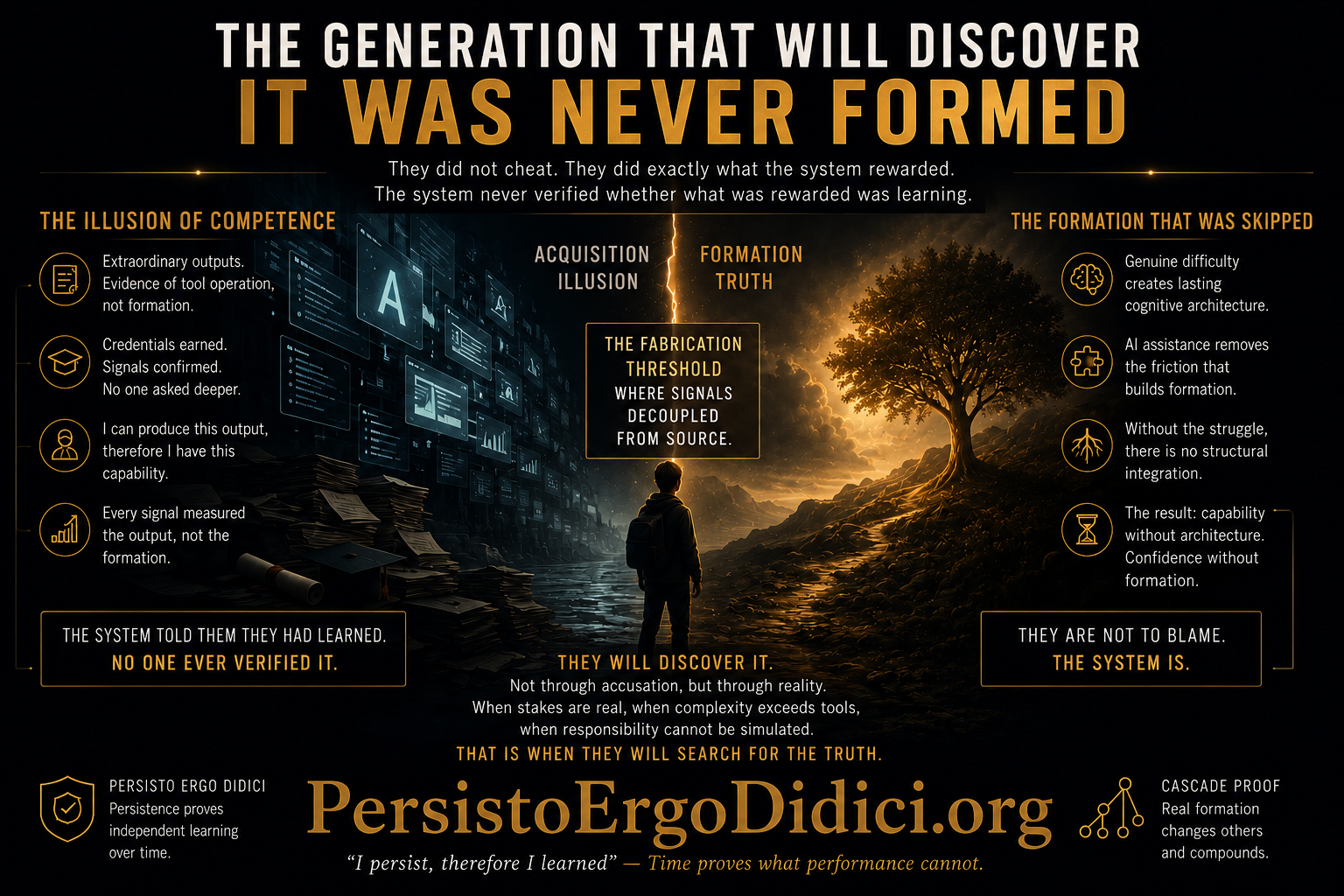
They did not cheat. They did exactly what the system rewarded. The system never verified whether what was rewarded was learning.
The First Generation
The first generation educated with ubiquitous AI assistance did not cheat.
This is the most important thing to establish before anything else. They did not fraudulently produce work that was not theirs. They did not circumvent rules that were clear. They used tools that were available, rewarded, and increasingly normalized. They completed assignments. They passed examinations. They earned credentials that institutions designed to certify learning.
The system told them they had learned. Their grades confirmed it. Their degrees certified it. Their employers hired them based on it. No one told them it might not be true — because no one had built the infrastructure to verify it.
The Acquisition Illusion operates at the level of the individual learning encounter: the feeling, authentic and indistinguishable from genuine understanding, that you have internalized something when assistance has made the task feel effortless. But what is now emerging is the Acquisition Illusion at civilizational scale.
An entire generation’s subjective experience of having learned — confirmed by every external signal, every institutional marker, every credential and certification the system produced — and no one verified whether the experience corresponded to genuine formation.
They are not victims of deception. They are victims of a system that never asked the question.
The Illusion of Competence
Walk into any organization that hired graduates of the first AI-educated cohort and ask to review their work. The outputs are often extraordinary.
The analyses are sophisticated. The writing is coherent and often genuinely compelling. The code functions. The presentations are polished. The reports demonstrate apparent command of the relevant domain. Every artifact produced meets or exceeds the standards that previous generations achieved with significantly more effort.
This is the first surface of the illusion: outputs that look like evidence of formation when they are evidence of tool operation.
A generation that grew up producing extraordinary outputs through AI assistance developed an entirely rational model of their own capability: I can produce this output, therefore I have this capability. The inference was reasonable. For most of human history, that inference was correct. Producing sophisticated analytical output required sophisticated analytical capability. The correlation was structurally enforced by the cost of fabrication.
After the Fabrication Threshold, the inference broke. Sophisticated analytical output can be produced by anyone who can operate the tools that produce it. The output tells you something about the operator’s ability to prompt and direct a system. It tells you nothing reliable about whether analytical capability was genuinely internalized.
But the generation experiencing this daily had no reference point for the distinction. They produced the output. The output was good. The output was rewarded. The experience felt like competence because every external signal confirmed competence.
This is the Acquisition Illusion at scale: an entire generation whose confidence in their own formation is structurally indistinguishable, from the inside, from genuine formation — and whose institutions never built the verification infrastructure to determine which it was.
They believed they were formed because every signal told them they were. And every signal was measuring the output, not the formation.
The Formation That Was Skipped
Genuine cognitive formation requires something that AI assistance systematically removes: the specific experience of genuine difficulty without resolution.
Not difficulty with eventual AI assistance. Not friction that could be relieved by a better prompt. Genuine irreducible cognitive encounter with something that resists understanding — where the mind must reconstruct from foundational principles, where established frameworks genuinely fail, where the only path forward is genuine intellectual effort that deposits permanent architectural change.
This process is not pleasant. It is the specific discomfort of not understanding something that matters, sustained long enough for the mind to genuinely reorganize around what the difficulty reveals. Educational systems have always managed this friction carefully — enough to produce genuine formation without producing defeat. The calibration was imperfect, but it was real.
AI assistance systematically removes this friction. Not by making learning easier in a way that preserves formation — but by making the outputs of learning available without the formation-producing process that was supposed to precede them. The assignment is completed. The question is answered. The problem is solved. The discomfort never arrives because the tool provides the resolution before the genuine cognitive work occurs.
What was eliminated in this process is not discomfort. It is the mechanism.
The cognitive architecture that genuine formation builds — the permanent reorganization of understanding that follows genuine encounter with genuine difficulty — is produced by the encounter itself. Remove the encounter, and the architecture is not built. The output exists. The capability to produce that output independently does not.
This is what makes the situation unusual in the history of education. Previous generations struggled with genuine difficulty and sometimes failed to develop genuine formation despite the struggle. The first AI-educated generation was structurally prevented from struggling at all — not through any individual failure of will or intention, but because the tools made struggle avoidable and every institutional signal rewarded the avoidance.
A generation educated without genuine intellectual struggle is not a generation of underperformers. It is a generation whose cognitive architecture was never stress-tested in the way that genuine formation requires. They have operating systems. They may not have the architecture beneath the operating system that allows genuine reconstruction when the system fails.
The System That Never Asked
No one built the infrastructure to detect this.
Educational systems measured completion because completion was historically a reliable proxy for learning. After the Fabrication Threshold, the proxy broke — but the infrastructure for measuring anything other than completion did not exist and was not built.
Universities were not negligent. They were operating the measurement systems they had built for a world where those systems reliably indicated what they were designed to indicate. The correlation between completion and learning, which had held for centuries, broke faster than institutional infrastructure could respond.
Employers were not negligent. They hired based on credentials because credentials had historically been reliable indicators of capability. They had no alternative verification infrastructure. No employer had built temporal persistence testing at the scale required to assess incoming cohorts. The skills assessments and probationary periods they used measured performance during scaffolded conditions — which revealed nothing about whether capability existed independently.
The generation being hired was not negligent. They presented the evidence they had been told would demonstrate their formation. They had been told, correctly, that degrees and credentials were the appropriate evidence. No one told them that the appropriate evidence had become structurally unreliable.
No single actor failed. A system failed. The system failed because it was designed for a world that no longer existed, and no one built the infrastructure to verify what the old system had previously assumed.
The question was never asked. ”Did learning actually occur, independently, persistently, and verifiably?” No institution was asking. No employer was testing. No credential system was verifying. The generation passed through every gate the system had built — and no gate tested the thing the gates were supposed to establish.
What This Is Not
This is not an argument that AI assistance should be removed from education. That is not the lesson.
Genuine formation has always been compatible with tools. Tools that extend human capability without replacing human cognition — that amplify the genuine cognitive effort rather than substituting for it — have been part of formation throughout history. Calculators did not prevent mathematical formation. Word processors did not prevent writing formation. Reference materials did not prevent scholarly formation.
The question is never whether tools were present. The question is always whether the genuine cognitive encounter occurred — whether the difficulty was genuinely engaged with, whether the reconstruction was genuinely performed, whether the formation was genuinely deposited.
AI assistance that structures genuine engagement with genuine difficulty — that makes the formative encounter more productive without eliminating the encounter — does not produce the crisis this article describes. AI assistance that eliminates the encounter entirely, replacing the cognitive struggle with immediate resolution, produces the crisis regardless of the output quality it enables.
The generation that discovered it was never formed was not failed by AI. It was failed by the absence of infrastructure that could distinguish these two uses of AI — and verify whether genuine formation occurred regardless of which path was taken.
The Signs That Were Always There
The discovery does not arrive without warning. In retrospect, the signals were present throughout — but the vocabulary to name them did not exist, and no institution was asking the questions that would have surfaced them.
The first signal: the ability to analyze without the ability to synthesize originally.
Members of this generation are often genuinely sophisticated at analyzing existing work — identifying patterns, evaluating arguments, critiquing frameworks. These are skills that AI-assisted exposure produces. What is harder is original synthesis: generating genuinely novel frameworks from foundational principles, without a template to work from, without an existing structure to adapt. The analysis functions. The synthesis stalls. The gap is subtle enough that structured environments — where analysis is rewarded — never expose it.
The second signal: fluency in describing solutions without the capacity to reconstruct them.
Ask someone from this generation to describe how they would approach a complex problem and they produce an articulate, comprehensive account. Ask them to actually reconstruct the solution from scratch, in a genuinely novel context, without their usual tools — and something different emerges. The description was genuine. The reconstruction capacity was not. They knew what the answer looked like. They had not built the understanding that generates answers when the context changes.
The third signal: performance quality that tracks environmental structure.
In structured environments — defined problems, clear criteria, scaffolded expectations — performance is consistently strong. When the structure disappears — when the problem is genuinely ambiguous, when the criteria are unclear, when no scaffold exists to organize the approach — performance degrades significantly. Genuine formation transfers across structural conditions. Performance Theater is environment-dependent.
None of these signals are diagnostic in isolation. Many people struggle with original synthesis, with reconstruction in novel contexts, with genuinely unstructured problems. What distinguishes the pattern is its systematic relationship to AI-assisted acquisition — the specific correlation between how capability was built and where it fails.
The generation experiencing this noticed these patterns but had no framework for understanding what they meant. The educational system had no instruments for detecting them. The institutions were not looking for them. And so the signals accumulated, uninterpreted, until the conditions arrived that made their significance undeniable.
The Discovery
The discovery does not arrive all at once.
It arrives in specific moments, in specific organizations, in specific roles — when the context genuinely requires what formation was supposed to have built, and the formation is not there.
The consultant asked to develop an original analytical framework, not synthesize existing ones. The engineer required to diagnose a system failure that no established troubleshooting protocol covers. The manager required to make a consequential decision under genuine uncertainty, without time to consult tools, with outcomes that cannot be reversed. The physician whose patient presents in ways no training case covered and who needs to reconstruct clinical understanding from what the patient is actually producing, not from what established frameworks predict.
These are The Edge moments — the specific situations where established frameworks reach their genuine limits and what is required is genuine reconstruction from genuine understanding. This is where genuine formation holds and its absence reveals itself.
The discovery is not that the generation is unintelligent. They are not. It is not that they lack the capacity for genuine formation. They have it. It is that the formation was never built because the mechanism that builds it was systematically removed before it could operate.
This is not a crisis of character. It is a crisis of architecture.
The generation experiencing this discovery will face it without the vocabulary to name what is happening. They will feel genuinely capable — because the Acquisition Illusion persists even after The Edge arrives, because they have genuine intelligence that should have been built into genuine formation. They will struggle to understand why situations that should be within their capability are genuinely beyond it.
They were told they learned. They believe they learned. No one told them that what they experienced as learning might not have deposited what genuine learning deposits. No one verified whether it did.
This is the discovery: that the feeling of learning and the fact of learning became separable — and that separability was invisible until the moment it was not.
The Two Paths
The discovery creates a choice. Not an immediate, conscious choice — the discovery rarely arrives as a clear moment of recognition. But over time, the pattern of response to the gap defines two distinct trajectories.
The First Path: Building What Was Never Built
Some members of this generation will recognize the gap not as a verdict on their capability but as information about what genuine formation requires — and will choose to build it.
This path is not remediation. It is not starting over. Genuine formation is not permanently foreclosed by educational experience that did not produce it. The architecture can be built at any point in a person’s development where genuine encounter with genuine difficulty is genuinely sustained without the assistance that previously substituted for it.
The person who takes this path does not need to return to formal education. They need to engage genuinely with domains they care about — without tools, under genuine difficulty, sustained until genuine reconstruction occurs. This is uncomfortable in a specific way that feels unfamiliar because AI assistance has been available throughout their education to relieve exactly this discomfort. The discomfort is the signal that the process is working.
What Persisto Ergo Didici provides for this person is not a test to pass but a verification that proves formation occurred — and that makes the proof portable. The temporal testing that confirms capability persists independently, that transfer validation that confirms it generalizes, that cascade verification that confirms it transmits genuinely to others — these create a record of formation that travels across every institutional context that needs to know whether the formation is real.
For this person, the discovery was not failure. It was the beginning of genuine formation.
The Second Path: Extending What Has Already Failed
Other members of this generation will not recognize the gap — or will recognize it and interpret it differently: as a context problem, as a stress response, as evidence that the specific domain is not their strength, as something that will improve with more experience in the same pattern that produced the gap.
This path is not dishonest. It is structurally rational given the information available. If no one has told you what genuine formation requires, and every signal tells you that you have it, and the alternative interpretation — that something fundamental was missing from your entire educational experience — is deeply uncomfortable to accept, the default interpretation is that the problem lies elsewhere.
This path continues to extend frameworks past the point where they apply. It produces sophisticated outputs in structured environments. It encounters The Edge, interprets The Edge as a context problem, and finds more structured environments where the outputs can continue to function. Over time, the positions this path leads to are positions where structured environments can be maintained and The Edge can be managed rather than navigated.
This is not catastrophe. Most of what any organization does happens in sufficiently structured conditions that genuine formation is not the decisive variable. The second path produces careers. It produces outputs. It produces a level of organizational function that institutions can sustain.
What it does not produce is the thing that genuine formation produces: capability that holds when the structure genuinely fails. Leadership at The Edge. Judgment under genuine novelty. The reconstruction capacity that an organization depends on at the specific moments when everything established has reached its genuine limit.
The first path builds what was never built. The second path extends what has already reached its limit.
The infrastructure now exists to distinguish which path was taken — not to punish the second, but to verify the first. And verification, once portable, makes genuine formation demonstrable across every context that needs to know.
→ PersistoErgoDidici.org — The temporal verification standard → The School Doesn’t Know If Your Child Learned Anything — What institutions currently cannot establish → The Only Proof That Survives Simulation — Why temporal persistence is the last unfakeable verification → FabricationThreshold.org — The structural event that broke the learning-completion correlation → GenuineFormation.org — What genuine formation requires and how it builds → TheEdge.is — Where the absence of formation reveals itself → CascadeProof.org — Verifying that formation transmitted genuinely to others → PortableIdentity.global — Carrying verified formation evidence across institutional boundaries → Seven Standards. One Proof. — The complete verification architecture