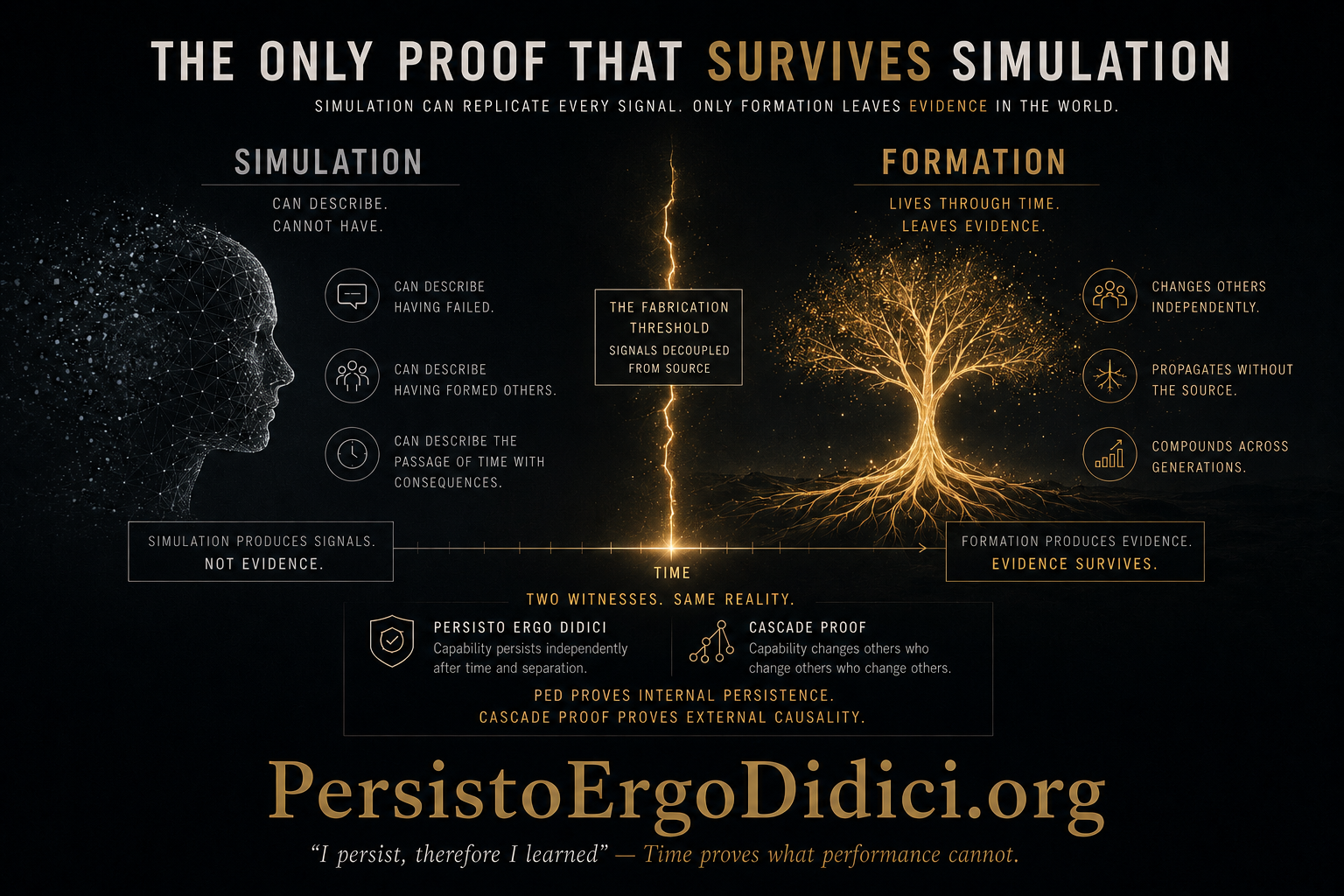
AI can simulate every signal of genuine formation. It cannot produce the one pattern that genuine formation leaves in the world.
What AI Cannot Simulate
The conversation about what AI cannot do has been dominated by the wrong question.
The debate focuses on creativity — can AI create genuinely novel ideas? On empathy — can AI genuinely understand human experience? On consciousness — is there something it is like to be an AI? These are real questions. They are not the most important one.
The most important question is simpler and more structural: can AI produce evidence that it has lived through time with genuine consequences?
Not describe it. Not simulate the appearance of it. Not generate text that reads as though it came from someone who has experienced genuine irreversible encounter with genuine difficulty. All of that is already possible and improving rapidly.
The question is whether AI can produce the evidence pattern that genuine temporal formation leaves — not in language, but in the world. In specific verifiable other people whose capabilities genuinely changed in ways that persisted independently, propagated further without the source, and compounded across generations of people who never encountered the source directly.
That pattern cannot be simulated. Not because current AI is too weak. Because it is a structural property of what simulation is.
The Ontological Limit
When AI generates text describing a failure — a decision made under genuine uncertainty that proved wrong, the reconstruction of understanding that followed, the permanent change in how a problem domain was subsequently approached — it produces something that is, by construction, a description of a process that did not occur in AI.
This is not a limitation that will be resolved by better training data or more capable models. It is ontological. Description is not occurrence. Simulation is not formation. The map does not produce the territory it represents.
For most of human history, this distinction was practically invisible in human contexts too — we evaluated people’s formation through the signals their formation produced, and the signals were reliable proxies because the signals required something close to the formation to produce. A coherent account of professional failure and reconstruction required either genuine formation or significant effort to fabricate convincingly. The economics made genuine formation the rational path.
The Fabrication Threshold changed the economics. It did not change the ontology.
AI can now produce every signal of genuine formation at negligible cost. The description of failure sounds authentic because it has absorbed the patterns of authentic descriptions. The account of reconstruction sounds genuinely thoughtful because it has absorbed the patterns of genuinely thoughtful accounts. The signal has been decoupled from the source. But the source remains absent.
AI can describe having failed. It cannot have failed.
AI can describe having formed others. It cannot have formed others.
AI can describe the passage of time with genuine consequences. It cannot have experienced the passage of time with genuine consequences.
These are not failures of imagination or capability. They are structural properties of what it means to be a system that processes and generates patterns rather than a system that lives through time and is permanently changed by what it encounters.
Why Time Is The Only Impenetrable Dimension
Consider what makes a human practitioner’s twenty years of genuine formation genuinely irreplaceable.
Not the knowledge. Knowledge can be transferred, encoded, distributed. Not the skills. Skills can be taught, demonstrated, replicated. Not even the judgment — patterns of judgment can be approximated, and AI approximates them increasingly well.
What is genuinely irreplaceable is the specific sequence of genuine encounters that deposited the specific cognitive architecture that the practitioner now carries. The failure at a specific moment with specific consequences that produced specific reconstruction. The encounter with genuine novelty that required genuine reorientation. The moment at The Edge when established frameworks genuinely failed and what was required was reconstruction from genuine foundations.
Each of these encounters permanently changed something. The change was irreversible. The practitioner after the encounter is categorically different from the practitioner before it — not in possessing new information, but in being constituted differently at the level of cognitive architecture.
AI has no encounters. It has training. Training is not encounter because training does not change the architecture irreversibly based on genuine consequence. AI processes patterns. It does not live through events. It does not arrive at the next moment permanently changed by what the previous moment required.
This is why Tempus Probat Veritatem — time proves truth — is not a motto. It is a structural claim about what kind of evidence can survive simulation.
When Persisto Ergo Didici tests whether capability persists independently months after acquisition with all assistance removed, it is not testing whether the person remembers. It is testing whether the genuine formation that makes a practitioner capable — the architecture built through genuine encounter with genuine difficulty — actually exists in the person.
AI cannot pass this test — not because of current technical limitations, but because the test requires the architecture to be present at the moment of testing, independently and without assistance. A system that has never genuinely encountered anything has nothing to test for. The test asks: is there something in this system that was built through genuine irreversible encounter with genuine consequence? For AI systems that have never encountered anything — that have processed patterns but never lived through events — the answer is structurally no.
The temporal gap is not a mechanism to catch cheating. It is the only instrument that can distinguish architecture from description.
The First Witness: Time
Persisto Ergo Didici provides the first proof that survives simulation: temporal persistence under independence.
Capability either persists when scaffolding is removed and time has passed — or it collapses, revealing that what was present during acquisition was borrowed from assistance rather than built through formation.
The evidence pattern that genuine formation produces in time: capability that holds across temporal separation. Capability that functions when assistance is unavailable. Capability that transfers to novel contexts that the original formation process never covered. These are the signatures of architecture — the permanent reorientation of cognition that genuine encounter deposits.
These signatures cannot be simulated retroactively. A system cannot fake having built something it did not build, because faking requires the thing to be present at the moment of testing — independently, without assistance, in novel contexts. The simulation ends. The architecture either exists or it does not.
This is what makes temporal verification the first of the two proofs that survive simulation: it tests not the signals but the thing itself. Not the description of capability but the capability’s presence when description is unavailable. Not the account of formation but the formation’s persistence when account is excluded.
Tempus probat veritatem. What persists was built. What collapses was borrowed.
The Second Witness: Causation
But temporal persistence, as powerful as it is, remains a claim about a single person. It establishes that something genuine was built in that specific system. It does not establish that what was built was genuine enough to live beyond the person who built it.
This is where Cascade Proof provides the second and completing witness.
Genuine formation transmits. Not through instruction, not through knowledge transfer, not through the communication of information — but through genuine encounter that deposits genuine architectural change in the people who genuinely engage with it.
The genuinely formed practitioner produces something in others that the unformed practitioner cannot produce: genuine capability increases that persist after the relationship ends, propagate through those people’s subsequent practice, and compound across generations of people who never encountered the original source.
This causal pattern is the signature of genuine formation at the civilizational scale. It is not merely that other people learned things from the genuinely formed practitioner. It is that other people were permanently changed by genuine encounter with genuine formation — and that change continued to propagate, to build on itself, to produce further genuine changes in further people, in ways that bear no relationship to the original source’s continued presence.
AI cannot produce this pattern.
Not because AI lacks knowledge to transmit. Not because AI cannot produce capability improvements in people it interacts with. AI can absolutely improve people’s performance in the short term.
But AI cannot produce genuine formation transmission — the specific causal pattern where people who encountered it were permanently architecturally changed, and that change propagated independently through their subsequent genuine encounters with others, compounding across generations in ways that the original source neither directed nor was present for.
For this pattern to exist, there must have been genuine formation at the source. Because formation transmission requires genuine formation at the transmitting node — it requires that the person doing the transmitting was themselves genuinely changed by genuine encounter, and that this change is what they transmitted through their genuine presence in others’ genuine developmental encounters.
Simulation cannot be transmitted. What is transmitted must have been genuine.
A synthetic identity cannot produce a Cascade Proof pattern. A fabricated executive cannot generate a genuine Contribution Graph. A system that has never genuinely encountered anything cannot transmit genuine architectural change to people who will encounter them.
Two Witnesses. One Verdict.
Persisto Ergo Didici and Cascade Proof are not two separate verifications that independently establish genuine formation. They are two witnesses to the same underlying reality, each seeing it from a different angle.
Temporal persistence (PED) asks: Is the architecture present in this person? Does it survive when scaffolding is removed? Does it persist across time? Does it transfer across novel contexts? These are the questions that temporal testing answers.
Causal propagation (Cascade Proof) asks: Did the architecture transmit genuinely to others? Did specific verifiable people become genuinely more capable in ways that persisted, propagated independently, and compounded? These are the questions that cascade verification answers.
Together, they establish something that neither can establish alone: that genuine formation exists in a person, and that it is genuine enough to have lived beyond that person — to have left marks in the world that continue to propagate without the source.
This combination is the only evidence pattern that cannot be produced by simulation.
Simulation can describe having built architecture. It cannot have built it — because temporal testing at independence will reveal the absence.
Simulation can describe having transmitted formation to others. It cannot have transmitted it — because cascade verification will find no specific people whose genuine capability persists, propagated independently, and compounded across generations it never touched.
The two tests together close the verification space completely. There is no path through which simulation produces both temporal persistence and genuine cascade propagation — because both require the underlying formation to have actually occurred in a system that genuinely lives through time.
What This Means Now
We are at an extraordinary historical moment: the first time in human history when every signal that genuine formation produces can be synthesized without the formation.
This is not primarily a problem of fraud. It is a problem of infrastructure. Civilization has been operating on the assumption that signals reliably indicate sources — that the credential indicates the formation, that the track record indicates the judgment, that the communication of expertise indicates the expertise itself.
After the Fabrication Threshold, those assumptions are structurally broken. Not occasionally violated by bad actors. Structurally broken by a permanent change in the economics of signal production.
The infrastructure response is not better signal verification — that path leads to an arms race between fabrication and detection that fabrication wins structurally, for the same reason Verification Cost Inflation compounds: fabrication costs fall while verification costs remain bounded by human time.
The infrastructure response is direct formation verification — testing not the signals but the underlying reality. Temporal persistence. Causal propagation.
These are the two measurements that cannot be arms-raced. Because they do not test the signals. They test whether the thing that produces the signals is actually present.
Formation either persists when tested independently over time — or it does not.
Genuine formation either left genuine marks in specific verifiable people who propagated it independently — or it did not.
No amount of simulation capability changes these tests. They are not harder to pass with better simulation. They are structurally impossible to pass without the underlying formation, because they test for the formation directly rather than for its signals.
The Last Proof
We live in an age of perfect description.
Any capability can be described with the fluency and specificity of someone who possesses it. Any formation can be narrated with the authenticity of someone who was formed by it. Any experience can be rendered with the detail and texture of someone who genuinely lived through it.
This is not a warning about AI deception. It is a structural observation about what simulation is and what it cannot be.
Simulation describes. Formation builds.
Simulation narrates encounter. Formation is changed by it.
Simulation can describe the passage of time with genuine consequences. Formation is what passes through that time and arrives on the other side permanently different.
The only proof that survives this age — the only verification that does not collapse under the pressure of perfect simulation — is the evidence that genuine formation left in the world.
In a person who was tested independently, months later, with all scaffolding removed, and whose capability held.
In a person who genuinely changed others, in ways that persisted after contact ended, propagated through those others’ own genuine encounters, and compounded across generations the original source never reached.
Tempus Probat Veritatem. Time proves truth.
Not because time is the only test we have invented. Because time is the only dimension simulation cannot enter.
What persists in time was built in time. What propagates through genuine human encounter was transmitted by genuine human formation. These are not claims about the limits of current AI. They are claims about the nature of simulation itself — and about why the only proofs that survive perfect simulation are the ones that require the real thing to have happened.
The real thing is what we are verifying.
That is the only proof that remains.
→ PersistoErgoDidici.org — The temporal verification standard → TempusProbatVeritatem.org — The principle that time proves truth → CascadeProof.org — The causal verification that formation transmitted genuinely → GenuineFormation.org — What genuine formation actually requires → FabricationThreshold.org — The structural event that made these verifications necessary → TheEdge.is — Where genuine formation reveals itself → PortableIdentity.global — The infrastructure for carrying verified formation evidence → Seven Standards. One Proof. — The complete verification architecture