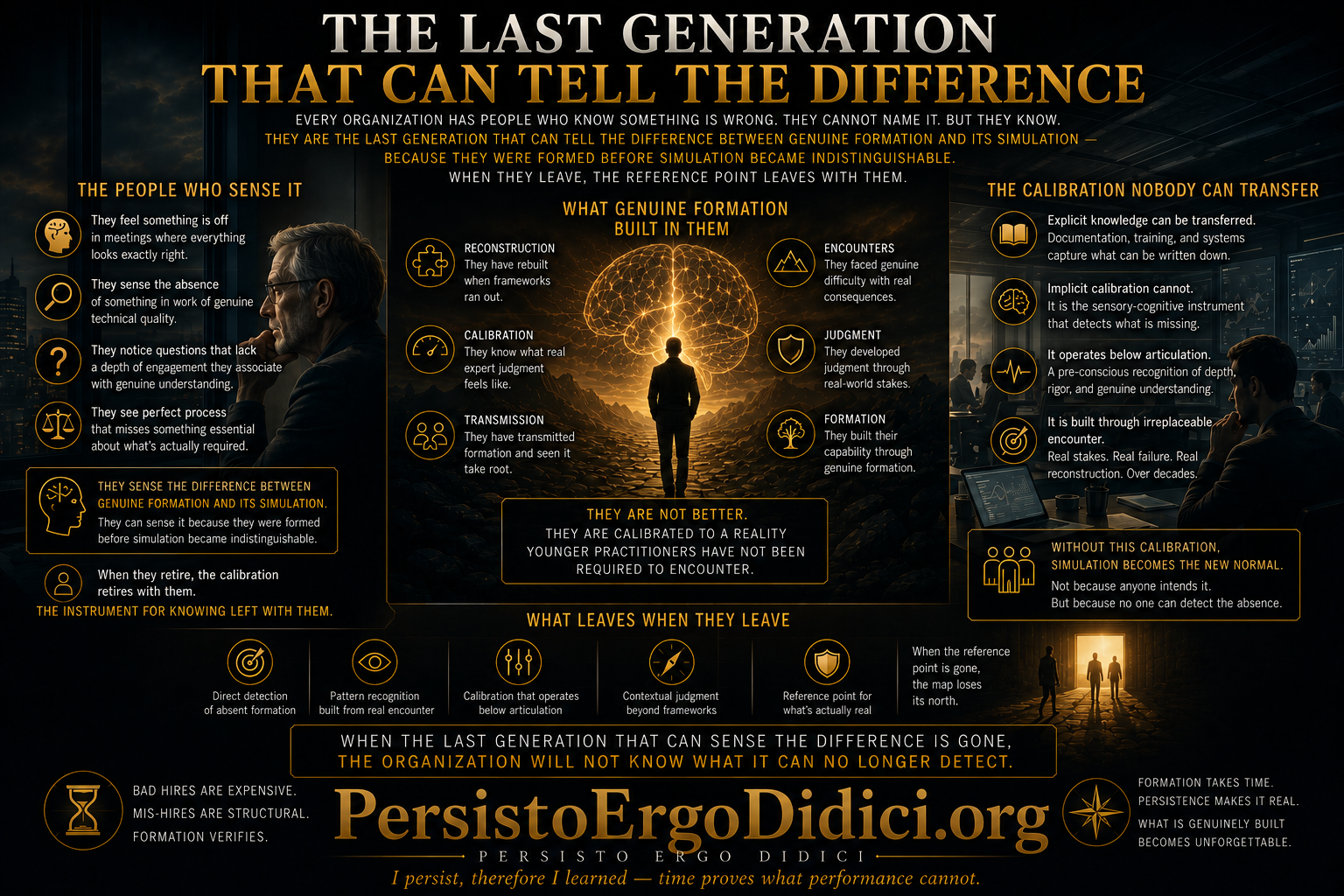
Every organization has people who know something is wrong. They cannot name it. But they know. They are the last generation that can tell the difference between genuine formation and its simulation — because they were formed before simulation became indistinguishable. When they leave, the reference point leaves with them.
The People Who Sense It
There is a specific type of person in most mature organizations. Senior. Experienced. Often quietly frustrated in ways they struggle to articulate. They sit in meetings where presentations are polished and analyses are sophisticated and everything looks exactly right — and they feel something is off. Not wrong in a way they can point to. Wrong in a way that is more fundamental than any specific error.
They watch junior colleagues produce work of genuine technical quality and sense the absence of something they cannot name. They notice that questions from newer hires, however intelligent, lack a specific depth of engagement that they associate with genuine understanding. They see decisions made with perfect process that miss something essential about what the situation actually requires.
They are not cynical about younger generations. They are not simply preferring the methods of their own era. They are sensing a specific structural gap — and they have no language for it.
What they are sensing is the difference between genuine formation and its simulation. They can sense it because they were formed before simulation became indistinguishable from formation. They carry an internal calibration built through genuine encounter with genuine difficulty in a world where that encounter was required — and that calibration functions as a detection instrument for its absence.
This calibration is not teachable in the traditional sense. It is not transmissible through explanation. It was deposited in them through decades of genuine professional encounter, and it lives in their cognitive architecture in ways they cannot fully articulate even to themselves.
When they retire, the calibration retires with them.
And the organization will not know what it lost — because the instrument for knowing left with them.
What Genuine Formation Built In Them
To understand what is leaving, it is necessary to understand what genuine formation actually builds — and why the specific historical moment of their formation matters.
This generation of senior practitioners was formed in a professional world where signal-optimization was substantially more expensive than genuine formation. Where producing sophisticated work product required having genuinely engaged with the domain. Where maintaining a credible track record of expert judgment required having genuinely developed that judgment through genuine encounter with genuine professional difficulty.
Not because they were more disciplined or more talented. Because the economics left them no other path. Fabrication was expensive. Genuine formation was the rational choice.
Through years of that formation — through genuine failures with genuine consequences, through situations that genuinely exceeded their frameworks, through the specific discomfort of not-understanding that resolves only through genuine reconstruction — they built something that is now genuinely rare:
A direct, embodied, calibrated sense of what genuine professional capability feels like from the inside, and what its absence feels like from the outside.
They know what genuine reconstruction looks like when a problem genuinely exceeds an established framework — because they have genuinely needed to reconstruct. They know what genuine calibration looks like in a domain-expert’s reasoning — because they have genuinely developed that calibration and felt the difference between having it and not having it. They know what genuine formation transmission looks like in a mentor-mentee relationship — because they have genuinely transmitted formation and seen it take root and propagate.
This is not nostalgia for their methods. It is a specific cognitive instrument, built through genuine encounter, that now functions as a calibration device for detecting the absence of genuine formation in others.
They are not better than younger practitioners. They are calibrated to a reality that younger practitioners have not been required to encounter.
The Calibration Nobody Can Transfer
The most consequential thing about this generation is not what they know. It is what they can sense.
Explicit knowledge can be transferred. Documentation, training, structured knowledge management — these can capture a significant portion of what senior practitioners know explicitly. Organizations invest heavily in this, and it matters.
What cannot be transferred is the implicit calibration — the specific sensory-cognitive instrument that genuine formation builds and that functions as detection equipment for its absence.
A surgeon with genuine clinical formation senses when a situation is departing from its expected trajectory before the monitoring instruments register the change. Not through explicit reasoning about specific indicators. Through a calibration built from genuine encounter with genuine clinical reality that has deposited a pattern-recognition capability below the threshold of conscious articulation.
A senior financial analyst with genuine formation senses when a market model has reached its genuine limits — when the coherence of the analysis no longer reflects the coherence of the underlying reality — before the positions move against it. Not through specific flags in the analysis. Through a calibration built from genuine encounter with genuine market dynamics that has deposited a sensitivity to framework-limit signals that cannot be explicitly specified.
A military officer with genuine operational formation senses when a tactical situation is departing from doctrine’s assumptions — when what the plan predicts and what the adversary is producing are diverging in ways that require reconstruction rather than execution. Not through specific protocol triggers. Through a calibration built from genuine operational encounter that has deposited a capacity for sensing The Edge that no training simulation fully replicates.
These calibrations are not teachable because they were not learned. They were deposited through encounter. The instrument for depositing them — genuine professional encounter with genuine consequence in a world where fabrication was expensive — is no longer the dominant experience of professional formation.
When this generation leaves, these calibrations leave. The organizations that held them will continue to function. They will continue to produce sophisticated outputs, execute established processes, and generate adequate results under normal conditions. They will not be able to sense the specific class of problems that their departing seniors could sense — and they will not know they cannot sense it, because the instrument for knowing that is what is leaving.
What the Organization Loses That It Cannot Measure
No offboarding process captures this. No knowledge management system retains it. No succession planning addresses it.
The explicit knowledge of departing seniors — their domain expertise, their process knowledge, their relationship networks, their historical context — is partially capturable and most organizations make some effort to capture it. This is the visible loss, the one that appears in transition planning.
The implicit calibration loss is invisible in every instrument organizations use to measure talent. It does not appear in competency frameworks. It is not assessed in performance management systems. It is not visible in the outputs of the people who remain after the departing senior leaves — until The Edge arrives and the output reveals its absence.
Here is what specifically disappears:
The ability to detect signal-optimization in real time. Senior practitioners with genuine formation can often sense — not always, not with certainty, but with a calibration that is better than chance — when a junior colleague’s sophisticated output reflects genuine understanding versus sophisticated synthesis without genuine comprehension. This is not explicit analysis of the output. It is pattern recognition below conscious threshold, built from having been in both states and felt the difference from both inside and outside.
When these practitioners leave, this detection capability leaves. The organization retains its evaluation processes — its structured interviews, its work sample tests, its performance reviews. These processes evaluate outputs. They do not detect the specific quality of the understanding that produced the outputs. The calibrated instrument for that detection was the senior practitioner. It is now gone.
The reference standard for what genuine excellence feels like. Junior practitioners who work alongside genuinely formed seniors receive something that no formal training transmits: direct exposure to what genuine professional excellence feels like in real professional contexts. Not the description of excellence. The embodied, specific experience of it.
This exposure operates partly below conscious threshold — the way that working alongside a genuinely excellent musician changes your ear even before you can articulate what changed. Something recalibrates. The junior practitioner’s sense of what good work is gets calibrated against genuine excellence rather than against the best signal-optimization they have encountered.
When the genuinely formed senior leaves, this calibration reference leaves. The junior practitioners who remain will calibrate against each other. The standard drifts — not suddenly, not dramatically, but persistently. Each generation calibrates against what the previous generation produced, rather than against genuine formation. The standard for excellence becomes self-referential. And excellence, so defined, is increasingly sophisticated signal-production.
The organizational immune response to formation absence. Genuine formation, when present in an organization’s senior practitioners, functions as a kind of immune response to the accumulation of formation absence in less senior roles. Not through explicit intervention — through the specific way that genuine formation shapes organizational culture, norms, and standards by example.
The genuinely formed senior asks different questions. They notice different things. Their standards create pressure — often invisible, often unspoken — that functions to make formation-absence more costly within the organization. This pressure is not always pleasant. The senior practitioner who can sense formation-absence does not always have the language for it, and the resulting friction is sometimes attributed to personality or generational preference rather than formation. But it functions.
When that generation leaves, the organizational immune response weakens. Formation-absence becomes less costly within the organization. The path of least resistance — signal-optimization without genuine formation — becomes more available. And nobody can see it happening, because the instrument for seeing it has retired.
The Cascade Proof That Is Walking Out The Door
Genuine formation transmits. The genuinely formed senior practitioner, over a career, produces something that extends beyond their individual capability: specific other practitioners whose formation was genuinely shaped by genuine encounter with the senior’s genuine formation.
This transmission is not uniform. Not every junior who works alongside a genuinely formed senior undergoes genuine formation transmission. But those who do carry something that the senior practitioner produced in the world — a causal mark that persists independently, propagates through others who encounter it, and compounds across generations of practitioners who never met the original source.
This is what Cascade Proof exists to verify: the specific pattern of genuine formation transmission that requires genuine formation to have been present and that Frictionless Formation cannot retroactively generate.
The generation of senior practitioners now approaching retirement carries Cascade Proof patterns that are, in many cases, unverified and undocumented. They exist in the world — in specific other practitioners whose formation was genuinely shaped by genuine encounter with these seniors — but nobody has mapped them, verified them, or made them portable.
When the senior retires, the Cascade Proof pattern does not disappear. It exists in the practitioners who carry it. But it becomes invisible to the organization and the field — undocumented, unclaimed, unable to function as verified evidence of what genuine formation produces.
This is the specific loss that Portable Identity and Cascade Proof are designed to address: not preserving the senior practitioner’s explicit knowledge, which documentation can partially achieve, but establishing the verified causal record of what their genuine formation produced in the world — so that this record can function as evidence, travel with those who carry it, and inform the next generation’s understanding of what genuine formation actually looks like.
The Organizations That Will Not Know What They Lost
This is the specific trajectory that is already underway in most mature organizations.
The last generation with pre-Threshold formation is retiring. The organizations they leave are not experiencing a sudden competence loss — they are experiencing a gradual recalibration. The outputs continue. The processes continue. The performance metrics continue to show adequate results. Nobody is failing in visible ways.
But the calibration is drifting. The reference standard for what genuine excellence looks like is becoming self-referential. The organizational immune response to formation absence is weakening. The Cascade Proof patterns that represent the genuine formation transmission of the departing generation are becoming invisible.
And there is no instrument in any organization’s measurement system to detect this. Because the instrument for detecting it is what is leaving.
In five years, the organization will not be measurably worse on any standard metric. In ten years, specific Edge-situations will begin to reveal something. In fifteen years, there will be a generation of senior practitioners who have never worked alongside someone with pre-Threshold formation — and who therefore have never been exposed to the calibrated reference standard that their predecessors carried.
They will not know what they are missing. They will not be able to name it. But they will sense that something is off — in the same way that the departing generation senses it now — without the language to explain what they are sensing or why.
The cycle will repeat. But without the reference point.
What Can Still Be Done
The calibration itself cannot be preserved in any document. The implicit, embodied instrument that genuine formation builds through genuine encounter is not transferable through explicit transmission.
But two things can be done that change what is lost.
Verification of the Cascade Proof patterns that exist. The genuine formation transmission that this generation produced — the specific other practitioners whose formation was genuinely shaped by genuine encounter with genuinely formed seniors — can be verified before the source retires. Temporal persistence testing of those practitioners. Causal verification of the formation transmission patterns. Documentation of what genuine formation transmission actually looks like in this specific domain, verified through the evidence it left in others.
This does not preserve the senior’s calibration. It preserves the verified evidence that genuine formation occurred and transmitted — evidence that can serve as a reference point for the organizations and fields that carry the practitioners it shaped.
Explicit mapping of what the calibration detected. The genuinely formed senior practitioner may not be able to articulate the calibration itself, but they can articulate specific instances of it — specific situations where they sensed something that explicit instruments missed, specific moments where their calibration functioned as The Edge-detection equipment it was. These articulations are imperfect evidence of the calibration, but they are evidence.
Systematic collection of these articulations — not as general wisdom, but as specific verified instances of calibration in action — creates an imperfect but real archive of what genuine formation’s detection instrument looks like when it operates.
Neither of these fully replaces what is leaving. Nothing does. But they are the difference between the reference point disappearing without trace and the reference point leaving verified evidence of what it was.
The last generation that can tell the difference is not gone yet. The window to document what they know — not explicitly, but through verified causal evidence of what their formation produced — is narrowing.
Tempus probat veritatem. Time proves truth. And time is running out to verify the truth before it cannot be verified.
→ PersistoErgoDidici.org — The temporal verification standard for what genuine formation produces → CascadeProof.org — Verifying the causal patterns that genuine formation leaves in others → The Only Proof That Survives Simulation — Why the calibration cannot be fabricated → The Employer Who Hired the Wrong Person — What formation absence costs organizations → GenuineFormation.org — What genuine formation actually requires and how it builds → TheEdge.is — Where the calibration’s absence becomes undeniable → PortableIdentity.global — Carrying the verified evidence of what formation produced → Seven Standards. One Proof. — The complete verification architecture