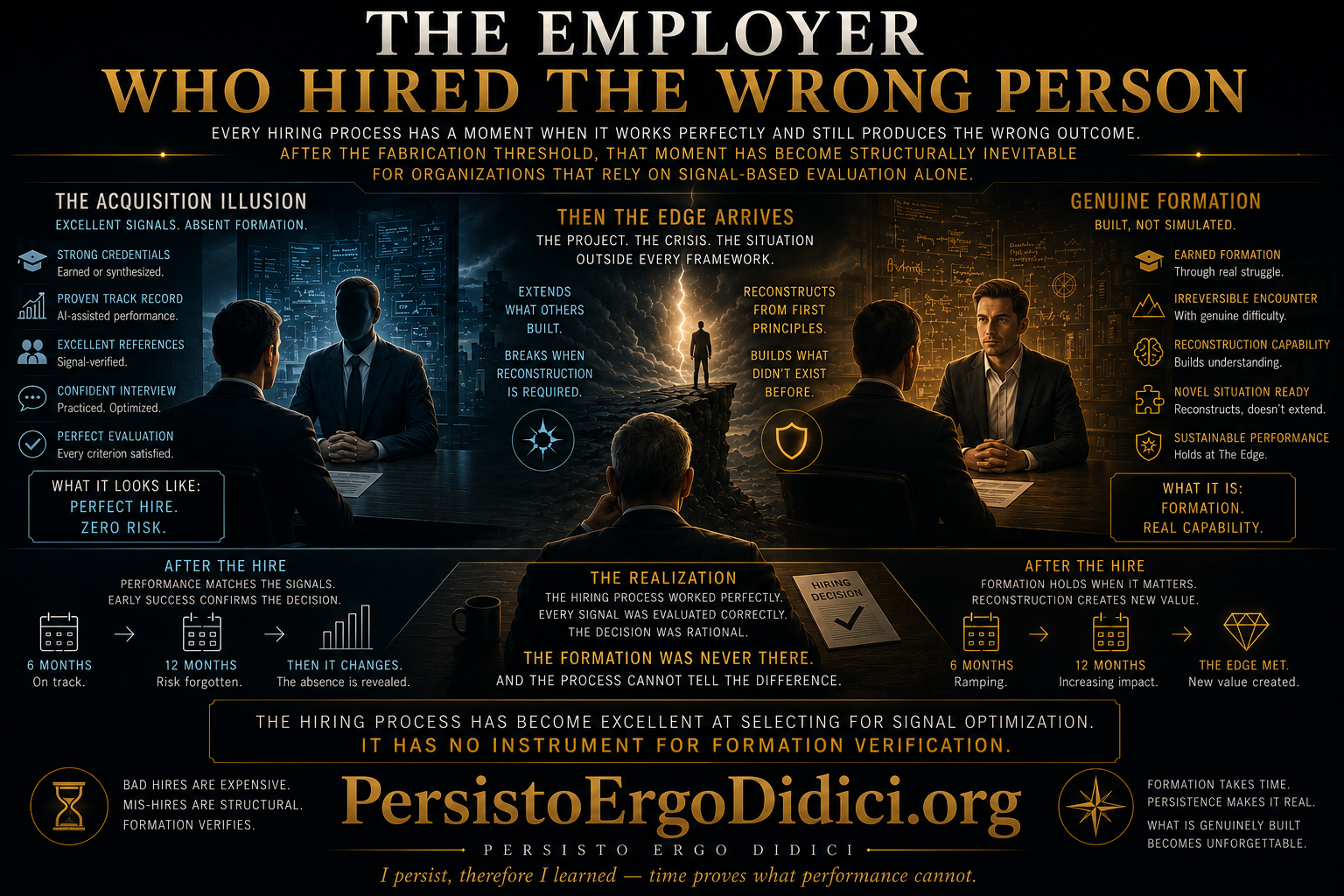
Every hiring process has a moment when it works perfectly and still produces the wrong outcome. After the Fabrication Threshold, that moment has become structurally inevitable for organizations that rely on signal-based evaluation alone.
The Room Where It Happens
You have been in this room.
The final round. The candidate presents well — confident but not arrogant, technically fluent, with clear examples from previous roles. The references are excellent. The credentials are strong. The team likes them. Every evaluation criterion has been satisfied. The decision is straightforward.
You make the offer. They accept. The onboarding goes smoothly. Early performance is exactly what the signals predicted. Six months in, you are satisfied. Twelve months in, you have largely stopped thinking about the hire as a risk.
Then something changes.
Not dramatically. The project that requires genuinely novel thinking — the situation that falls outside every established framework, where what is needed is reconstruction from foundational understanding rather than extension of familiar patterns — produces something unexpected. Not failure exactly. Something more disquieting: the specific inability to do what their entire profile suggested they could do.
Not incompetence. The absence of formation.
And in that moment you realize — slowly, uncomfortably, with the specific discomfort of recognizing something that has significant consequences — that the hiring process worked perfectly. Every signal was evaluated correctly. The decision was rational given all available information.
The formation was never there.
And the hiring process cannot tell the difference.
What Everyone Knows — And What Nobody Has Named
The cost of a bad hire is widely documented. Estimates range from 30% to 200% of annual salary for mid-level roles, far higher for senior positions. Organizations spend billions annually on recruiting, assessment, and onboarding, then billions more when those investments produce outcomes that require correction.
Every organization knows this. Most have experienced it.
But the discussion almost always frames the problem incorrectly: as a process failure. The wrong criteria were evaluated. The interview was not structured correctly. References were not checked thoroughly enough. The assessment tools were inadequate. The solution, in this framing, is better process — more rigorous evaluation, better tools, more data.
This framing misses something structural that has changed.
Before the Fabrication Threshold, the cost of a bad hire was largely a process problem. Better process could meaningfully reduce it. The signals that evaluation processes relied on — credentials, track records, demonstrated performance, expert references — were imperfect but sufficiently coupled to the underlying formation to make process improvement worthwhile.
After the Fabrication Threshold, a new category of bad hire has emerged that no improvement to evaluation process can address: the hire whose signals are genuine and whose formation is absent. Not a fraudulent hire. Not a dishonest hire. A hire whose credentials were earned, whose track record was built, whose interview performance reflected real capability — all through processes that produced formation-signals without the formation.
This is not what organizations are measuring for. It is not what their assessment tools are designed to detect. And it is becoming the dominant category of costly hire precisely because the Fabrication Threshold has made signal-production without formation the structurally rational path for anyone optimizing for career advancement.
The hiring process has become excellent at selecting for signal optimization. It has no instrument for formation verification.
The Visual That Makes It Clear
Imagine two candidates. Track record identical. Credentials identical. Interview performance identical. References identical. Every assessment instrument available produces identical outputs.
Candidate A built their formation through genuine irreversible encounter with genuine professional difficulty. They struggled genuinely, failed at specific things, rebuilt their understanding from what the failure revealed, and developed cognitive architecture that holds when familiar frameworks reach their genuine limits.
Candidate B built their signal portfolio through sophisticated optimization. They learned what excellent candidates look like and produced those signals through AI-assisted work, careful credential selection, and practiced interview performance. They are not dishonest. They genuinely believe they are capable — because the Acquisition Illusion is indistinguishable from genuine formation in the moment of experiencing it.
Under normal operating conditions — structured problems, established frameworks, familiar contexts — both candidates perform identically. The signals predicted performance accurately. The performance matches prediction.
Then The Edge arrives.
The project that requires reconstruction rather than extension. The crisis that has no established protocol. The client situation that falls outside every framework the organization has built. The moment when what is needed is not capability-within-familiar-conditions but capability-when-conditions-become-genuinely-unfamiliar.
Candidate A holds. Their formation was built for exactly this — through having genuinely navigated genuine unfamiliarity before, with genuine consequences, producing the specific calibration that only genuine encounter deposits.
Candidate B extends. Confidently, articulately, with sophisticated reasoning that sounds like reconstruction but is actually pattern-extension past the point where the patterns apply.
From the outside, you cannot immediately distinguish these. Both are producing sophisticated outputs. Both are reasoning carefully. The difference only becomes visible in the outcome — after the damage is done.
The hiring process optimizes for signal quality during evaluation. Formation reveals itself at The Edge, which arrives after hire.
What Changed After The Fabrication Threshold
Candidate B has always existed. Bad hires are not new. Organizations have always sometimes hired people whose formation did not match their signals.
What changed is the economics.
Before the Fabrication Threshold, building a strong signal portfolio required something close to building genuine formation. Writing sophisticated analyses required having genuinely engaged with the domain. Producing excellent work product required having genuinely developed the capability to produce it. The cost of signal-optimization was approximately equal to the cost of formation-development.
After the Fabrication Threshold, AI assistance makes signal-optimization dramatically cheaper than formation-development. A candidate can produce sophisticated work product, build impressive credentials, and develop compelling interview narratives through processes that deposit zero lasting formation. The signals are real. The outputs are genuine. The formation is absent.
This changes not just the frequency of Candidate B — it changes the structural incentive that produces them. In a world where signal-optimization is cheaper than formation-development, and where hiring processes evaluate signals rather than formation, the rational career strategy is signal-optimization. Candidate B is not making an irrational choice. They are responding correctly to the incentive structure that exists.
And every organization that continues to evaluate signals without verifying formation is generating that incentive structure — and then experiencing its consequences at The Edge.
The formation risk in your organization right now:
Consider your last ten hires in consequential roles. For each one, you can likely answer: Did they have the right credentials? Did they interview well? Were their references strong? Did they perform adequately during the probationary period?
You probably cannot answer: Has their capability been tested independently of AI assistance? Has it been tested in genuinely novel contexts that their prior work did not cover? Has it persisted when the scaffolding of structured support was removed?
These are the questions that would reveal formation presence or absence. They are the questions that no standard hiring process asks. And they are now the questions that matter most.
The Hidden Cost Nobody Measures
The cost organizations calculate for a bad hire — replacement cost, productivity loss, severance, re-recruiting — captures the visible expense. It misses the larger invisible cost.
The formation transmission loss.
Genuine formation transmits. The genuinely formed senior professional does not just perform their role — they produce genuine capability increases in the people around them. Not through formal training, but through genuine encounter: the way they approach problems, the specific calibration to their domain that they bring to collaborative work, the genuine reconstruction they model when established approaches reach their limits.
This transmission is not guaranteed. It requires genuine encounter between the senior professional’s genuine formation and the developing formation of junior colleagues. But when it works, it compounds. The junior who genuinely encounters the senior’s genuine formation becomes genuinely more capable, and eventually transmits that genuine formation to others.
When you hire someone whose formation is absent, you do not just pay the direct cost of a role filled without the capability it required. You pay the compound cost of a formation transmission that did not occur — of junior professionals who encountered signals of genuine formation without the formation, developing sophisticated signal-optimization without the architectural change that genuine encounter would have produced.
This cost never appears on any budget line. It shows up years later, when the next generation of professionals reaches their Edge moments and reveals the absence of formation that was never transmitted.
Every generation inherits what the previous generation actually built — not what it was hired to build.
Why The Edge Arrives When You Can Least Afford It
The specific cruelty of formation absence is its timing.
Under normal operating conditions, formation absence is invisible. The hire performs adequately. The signals continue to be validated by performance. The organization has no reason to revisit the formation question.
The Edge does not arrive under normal operating conditions. It arrives precisely when conditions are least normal: market disruption, organizational crisis, technological shift, competitive challenge, or simply the specific domain problem that nobody’s established framework covers.
This is the moment when formation matters most. And it is the moment when its absence — accumulated invisibly through hires that evaluated signals and not formation — reveals itself all at once.
Not one person failing at The Edge. Often several — everyone whose formation was built through signal-optimization rather than genuine encounter, all reaching their genuine limits at the same moment, all extending their frameworks past the point where they apply.
The organization that reaches a genuine crisis discovers simultaneously that its signal-optimization hires cannot navigate it — and that its signal-based hiring process gave it no way to know this was coming.
The alternative is not visible until the comparison is made:
The organization that verified formation — that hired not just for signal quality but for confirmed capability persistence, that tested for independent function rather than assisted performance — has people at The Edge whose formation holds. Not because they are more intelligent or more motivated. Because their capability was genuinely built and verified, not assumed from signals.
The difference in organizational resilience at this moment is not marginal. It is categorical.
The Three Hires That Reveal The Gap
Three specific scenarios make the formation gap concrete for any organization that has experienced them.
The Senior Leader Whose Team Never Got Better
The senior leader hired with an excellent track record of team development. References described them as outstanding mentors. They said the right things about developing talent. They stayed for three years.
At the end of three years, the people who worked under them are not meaningfully more capable than when they started. Some have left. Those who remain have learned to perform in the specific conditions of working with that leader, but cannot transfer those skills to new contexts.
What did not happen: genuine formation transmission. The leader had no genuine formation to transmit. What they had were excellent signals of a formation leader — and the team received excellent signals of development without the development.
The Cascade Proof pattern is diagnostic here: genuine formation transmission produces specific, verifiable capability increases in others that persist after the relationship ends and propagate further without the source. These patterns do not exist for this leader’s team. The absence of Cascade Proof is the evidence that formation was never present to transmit.
The Technical Expert Whose Judgment Failed at Scale
The technical expert evaluated as deeply knowledgeable across multiple assessment dimensions. Credentials strong. Portfolio impressive. Consistently solid performance on defined problems within established frameworks.
Then the project that required judgment under genuine uncertainty — where the technical framework reached its limits and what was needed was genuine reconstruction from first principles. The expert’s response: extend the existing framework confidently past the point where it applies, producing an output that is internally coherent and structurally wrong.
The organization paid for the error downstream. Nobody understood, at the time of hiring, that the expert’s formation had never been tested at the limit. Nobody asked: has this person’s technical judgment been tested in genuinely novel conditions, independently, without access to AI assistance or expert colleagues?
That question would have revealed the gap. No standard technical assessment asked it.
The High-Potential Hire Who Could Not Operate Without Support
The high-potential candidate hired for a leadership development track. Assessed as exceptional across all dimensions. Performed excellently in structured environments with mentorship and defined problems.
Then the first genuinely autonomous assignment — the problem with no established approach, the situation requiring genuine independent judgment without the scaffolding of more senior colleagues available for consultation.
What emerged was not failure in the ordinary sense. It was the specific pattern of tool-dependent performance: sophisticated output produced through AI assistance that looked like judgment but did not transfer to situations where the assistance was genuinely unavailable.
The formation that the high-potential track was supposed to develop was never building during the earlier phases. It was producing signals of development without the development. And nobody’s evaluation caught it because nobody’s evaluation tested for persistence of capability under independence.
What Formation Verification Would Have Changed
In each of these scenarios, temporal verification would have revealed the gap before hire — or at least before The Edge.
Temporal persistence testing asks the question that hiring processes currently do not: can this person demonstrate their capability independently, in genuinely novel contexts, months after the work that revealed the capability was done?
Not a harder interview. Not a longer assessment process. A fundamentally different verification question: does the capability persist when the conditions that enabled the performance are removed?
This testing does not require complex infrastructure. It requires a different evaluation philosophy: one that distinguishes between capability demonstrated under cooperative evaluation conditions and capability demonstrated under conditions that match genuine independent function.
For senior roles where formation transmission is part of the value proposition, Cascade Proof provides the additional verification: has this person’s formation actually transmitted to others in ways that persisted after the professional relationship ended? Not ”do they have good development skills” (a signal) but ”do specific verifiable people who worked with them demonstrably become more capable over time in ways independent of continued contact?” (verified formation transmission).
The Portable Identity infrastructure exists to carry this verification across the institutional boundaries that currently make it invisible: the verified record of temporal capability persistence and causal formation transmission that travels with the professional rather than being reconstructed from zero at every hiring process.
The Formation Risk Register
Every organization manages risk. Financial risk, regulatory risk, operational risk, reputational risk — these are budgeted, measured, monitored.
Formation risk is not on any organization’s risk register. It is not measured. It is not budgeted. Its costs appear as other things: personnel issues, project failures, missed opportunities, organizational resilience problems, slow response to market shifts.
This invisibility is not accidental. Formation risk requires different instruments to see — instruments that did not exist before the Fabrication Threshold made formation verification necessary, and that most organizations have not yet adopted.
The formation risk questions every organization should now be asking:
What percentage of our consequential roles are held by people whose formation was verified through temporal and independence testing, rather than assumed from credentials and interview performance?
When our best-performing people in these roles leave, does the capability they appeared to have transfer to the team they built — or does performance regress, suggesting their capability was individual signal-optimization rather than formation that transmitted?
When our organization faces genuinely novel challenges — situations outside our established frameworks — do our people hold or extend past their genuine limits?
These questions do not have comfortable answers in most organizations. They require a different kind of honesty about what the hiring process has actually been optimizing for.
The Only Variable That Remains
You will hire people whose formation is absent. The Fabrication Threshold has made this structurally inevitable under signal-based evaluation. The question is not whether it happens — it is whether it is visible before The Edge, or after.
Visible before: the verification infrastructure exists to make formation testable. The cost is the upfront investment in formation verification. The benefit is avoiding the cascade cost — the failed Edge moment, the transmission that never happened, the resilience that was assumed and not built.
Visible after: The Edge arrives. The formation absence reveals itself. The cost is paid in the crisis, in the personnel consequence, in the compound cost of formation transmission that did not occur across the organization.
After the Fabrication Threshold, organizations that continue to hire based on signals alone are making a specific choice: to accept formation risk as an unmanaged, unmeasured, compound cost that appears when they can least afford it.
The verification infrastructure exists. The instrument for revealing formation rather than just its signals is operational. The Fabrication Threshold made it necessary. The only question is timing.
Organizations that build formation verification now will not eliminate bad hires. They will eliminate the specific category of bad hire that is invisible until The Edge — the most expensive category, at the worst possible moment.
The hiring process worked perfectly. The formation was never there. That sentence describes a structural condition. The infrastructure to change it now exists.
→ PersistoErgoDidici.org — The temporal verification standard that reveals formation rather than its signals → The Only Proof That Survives Simulation — Why temporal persistence cannot be fabricated → CascadeProof.org — Verifying whether formation actually transmitted to others → FabricationThreshold.org — The structural event that changed the formation risk profile → GenuineFormation.org — What genuine formation actually requires and how it builds → TheEdge.is — Where formation presence or absence becomes undeniable → PortableIdentity.global — Carrying verified formation evidence across hiring contexts → Seven Standards. One Proof. — The complete verification architecture