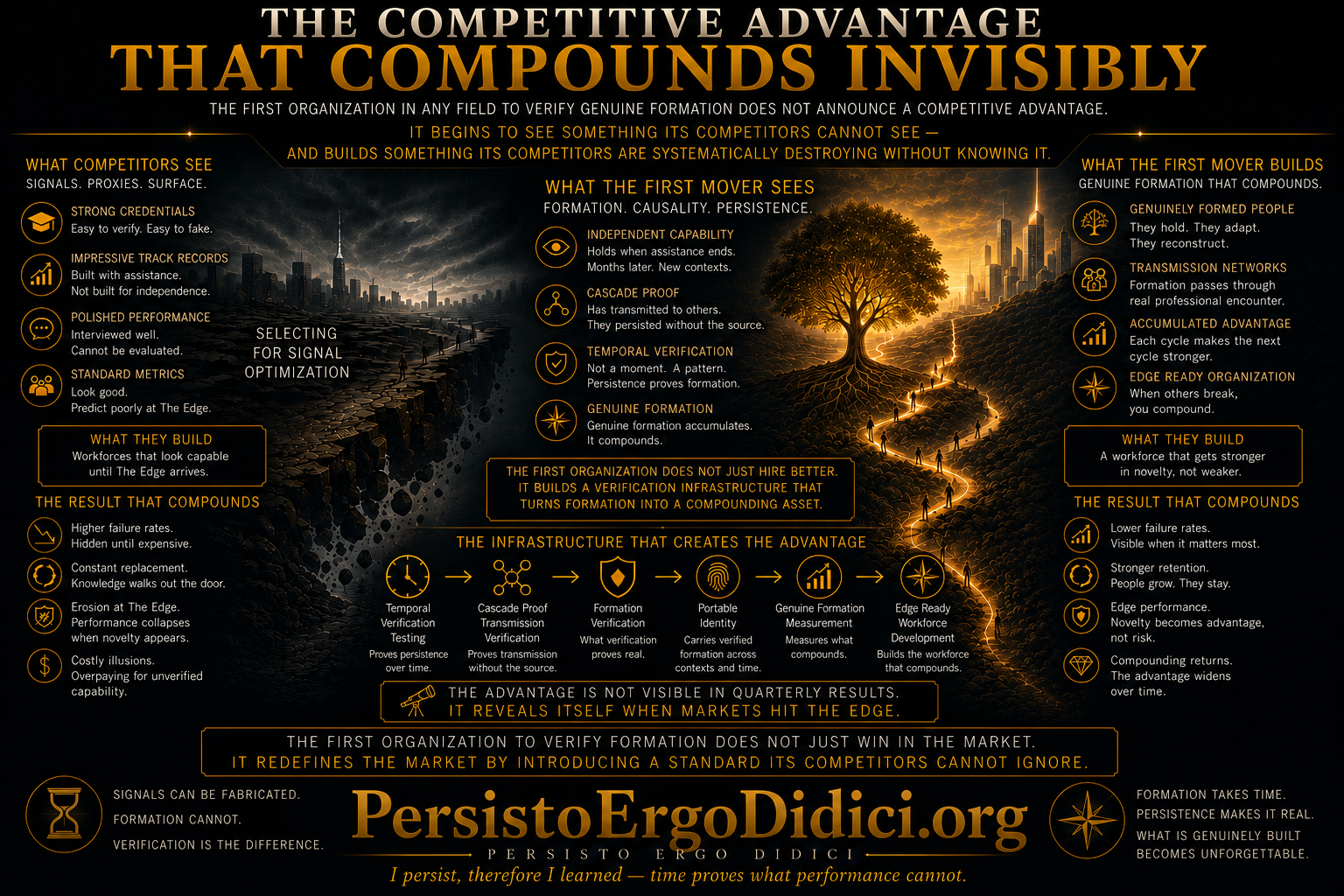
The first organization in any field to verify genuine formation does not announce a competitive advantage. It begins to see something its competitors cannot see — and builds something its competitors are systematically destroying without knowing it.
The Moment Before the Separation
Markets do not separate into winners and losers through single decisions. They separate through accumulated differences in what organizations can see, what they optimize for, and what they build while their competitors are building something else.
The first organization in any field to implement genuine formation verification will not announce a competitive advantage. It will not immediately outperform its competitors on standard metrics. In the short term, its process will be slower, its evaluation criteria harder to satisfy, its candidate pool smaller because fewer candidates will pass temporal verification than signal-based screening.
The separation begins invisibly and compounds.
While competitors are selecting for Signal Optimization — the candidates whose credentials are strongest, whose interview performance is most polished, whose track records are most impressive — the first organization to verify formation is selecting for something different. It is selecting for capability that persists when assistance ends, that functions independently in genuinely novel contexts, that has demonstrably transmitted to others in ways that persisted without the source.
These are different people. Not better educated. Not more intelligent. Not more motivated. Differently built. And in the first years after implementation, the difference is not visible in any standard performance metric.
Then The Edge arrives.
What the First Mover Sees That No One Else Can
The organization that implements formation verification develops an instrument that its competitors do not have: the ability to distinguish genuine formation from sophisticated Signal Optimization in real time.
This sounds abstract. It is operationally concrete.
Consider what this organization sees in a candidate pool that its competitors see differently:
Candidate A presents with a strong credential portfolio, polished interview performance, and an impressive track record. Under standard evaluation, this candidate is highly competitive. Under temporal verification testing — capability demonstrated independently, months after the work that revealed it, in genuinely novel contexts — the performance reveals formation absence. The capability was signal-optimized, not genuinely built. It does not persist when the conditions that produced it are removed.
Candidate B presents with a slightly less polished profile. The credentials are strong but not exceptional. The interview is confident but occasionally reveals genuine uncertainty rather than smooth performance. The track record includes specific instances of having worked through genuine difficulty rather than producing uniformly excellent outputs. Under temporal verification, this candidate’s capability holds under independence, transfers to novel contexts, and shows evidence of having transmitted to others in verifiable ways.
Standard evaluation selects Candidate A. Formation verification selects Candidate B.
Over ten hiring cycles, the organization with formation verification has built a fundamentally different workforce than its competitors — not because it found smarter people, but because it distinguished between two types of capability that look identical under the instruments its competitors use.
The first organization that verifies formation does not just hire better. It begins to see a dimension of the talent market that its competitors cannot access — because they have not built the instrument for seeing it.
The Accumulation That Compounds
Genuine formation does something that Signal Optimization cannot: it transmits.
The genuinely formed professional produces genuine capability increases in the people around them — not through formal training, but through genuine encounter. The calibration to their domain that they carry, the specific architectural changes that genuine difficulty produced in them, the capacity for reconstruction when established frameworks fail — these transmit through genuine professional contact in ways that persist after the contact ends.
This transmission is what Cascade Proof verifies: the causal pattern of genuine formation transmission that requires genuine formation to be present and that Frictionless Formation cannot produce.
The organization that consistently hires genuinely formed people is not just filling roles with capable individuals. It is building a formation transmission network — a compounding asset of genuine capability that grows as each genuinely formed professional transmits to those around them, who transmit to others, who transmit further in ways that the original source never directly influenced.
This is Genuine Formation: the accumulated genuine formation within an organization, verified through temporal persistence testing and causal transmission patterns, that compounds across the organization as genuine formation transmits through genuine professional encounter.
Its competitors are building something different — and do not know it.
Organizations that select for Signal Optimization are building Signal Optimization: polished, impressive-looking capability that performs excellently under cooperative evaluation conditions and degrades when those conditions end. Signal Optimization does not compound. It does not transmit — because there is nothing genuine to transmit. It produces excellent outputs under normal conditions and reveals its absence at The Edge.
The first organization that verifies formation is building Genuine Formation while its competitors build Signal Optimization. In the short term, both look like adequate talent acquisition. In the medium term, specific situations begin to reveal the difference. In the long term, the organizations have built fundamentally different capabilities — and only one of them knows it.
The Three Compounding Advantages
Formation verification produces three compounding advantages that accumulate over time.
Advantage One: Edge Performance
The Edge arrives for every organization. Market disruption, competitive crisis, technological discontinuity, novel client problem that no established framework covers — every organization eventually faces situations that require genuine reconstruction rather than extension of established approaches.
The organization with Genuine Formation navigates The Edge differently. Not because its people are smarter or more motivated — because their formation was built through genuine encounter with genuine difficulty and holds when familiar frameworks fail. The genuinely formed professional at The Edge reconstructs. The signal-optimized professional at The Edge extends — past the point where the framework applies, confidently, with well-reasoned outputs that are structurally wrong.
This difference is not visible under normal conditions. It is decisive at The Edge. And The Edge is precisely the moment when competitive differentiation matters most — crisis, disruption, opportunity that requires capabilities the organization either has or discovers it does not.
Advantage Two: Formation Transmission Efficiency
The genuinely formed professional transmits formation to those around them. This transmission is not uniform — not every colleague relationship produces genuine formation transmission — but where it occurs, it produces capability increases that persist and compound.
The organization that consistently employs genuinely formed professionals is operating a formation transmission network that its signal-optimized competitors are not. Its junior employees are being exposed to genuine professional formation — not descriptions of excellence, but direct encounter with it — in ways that produce genuine architectural change in those who genuinely engage with it.
This compounds across the organization over time. Each generation of junior professionals trained alongside genuinely formed seniors becomes, in some proportion, genuinely formed themselves — and capable of transmitting genuine formation to the next generation. The Genuine Formation builds recursively.
The signal-optimized organization’s junior employees are being exposed to excellent signal production — and learning, through observation and encounter, to produce excellent signals. They learn to optimize effectively for the criteria that their organization evaluates. They become excellent at the evaluation conditions. They do not develop the formation that genuine difficulty produces, because the professionals around them did not develop it either.
Advantage Three: Organizational Immune Response
The organization with genuine Genuine Formation develops something that its competitors do not have: an organizational immune response to the accumulation of formation absence.
When genuinely formed professionals are present in an organization’s leadership and senior ranks, they function as a natural detection instrument for the absence of formation in roles they interact with. Not through explicit assessment — through the specific way that genuine formation shapes what questions get asked, what standards are applied, what dissonance is sensed and responded to.
This immune response is imperfect and uneven. But it is real. Organizations with high Genuine Formation in senior roles are harder to fill with signal-optimized candidates at all levels, because the genuinely formed seniors sense the absence in ways that surface in hiring and evaluation processes even without formal formation verification infrastructure.
As Genuine Formation accumulates through Genuine Formation hiring, the immune response strengthens. The organization becomes progressively better at naturally detecting formation absence even without formal verification — because the detection instrument (genuinely formed professionals) is present in greater density and at higher influence levels.
The Market Moment
There is a specific moment in every market’s evolution when one organization’s different approach becomes legibly visible to others — when the compounding advantage from Genuine Formation begins to show up in metrics that competitors can observe and in capabilities that the market can perceive.
This moment does not arrive through announcement. It arrives through outcomes.
The organization that navigated a crisis better than its competitors — not because it had better information or more resources, but because its people genuinely reconstructed when reconstruction was required. The organization that consistently develops junior talent in ways its competitors cannot replicate — because its formation transmission network is producing genuine capability increases that its competitors’ signal-optimization network cannot produce. The organization whose senior practitioners can sense things that their counterparts in competing organizations miss — because Genuine Formation has compounded to the point where the organizational immune response is functioning at organizational scale.
These outcomes will initially be attributed to other factors. Better strategy. Better culture. Better leadership. The Genuine Formation explanation requires a framework that most markets do not yet have.
But the first organization in any field that implements formation verification and accumulates Genuine Formation over time will eventually produce outcomes that cannot be explained by standard competitive factors — because they are produced by a factor that standard competitive analysis does not measure.
First-mover advantage in genuine formation verification is not a technology advantage. It is a seeing advantage. The organization that learns to see what its competitors cannot see builds something its competitors cannot replicate — because they do not know what they are failing to build.
What Implementation Actually Looks Like
Formation verification is not a replacement for existing hiring processes. It is an additional verification layer that tests what existing processes cannot test.
The operational implementation has three components:
Temporal persistence testing for candidates in consequential roles: capability demonstrated independently, in genuinely novel contexts, months after the work that initially revealed the capability. Not a harder interview. A different kind of evaluation — one that tests whether capability persists when conditions change, rather than whether it is present under evaluation conditions.
Cascade verification for senior roles where formation transmission is part of the value proposition: documented evidence of specific individuals whose formation was genuinely shaped by genuine encounter with this candidate, in ways that persisted after the professional relationship ended. Not references that describe how excellent the candidate was. Verified causal evidence of what they actually transmitted.
Portable Identity carries Genuine Formation evidence across every institutional boundary — so that what temporal testing and causal verification established travels with the professional rather than being reconstructed from zero at each new context.
These three components together create a fundamentally different evaluation capability — one that can distinguish genuine formation from Signal Optimization in the specific ways that matter for consequential roles.
The early adopter organization gains additional time to develop formation verification competency before its competitors recognize the advantage it is building. It develops the assessment infrastructure, the evaluator training, and the institutional knowledge of what genuine formation looks like when verified — before the market begins to compete for formation-verified talent.
The Cost of Not Being First
The organization that waits — that continues to select for Signal Optimization while competitors begin to verify formation — is not maintaining a neutral position. It is making an active choice with compounding consequences.
Every year of signal-based selection while competitors verify formation produces three specific costs:
Accumulated Formation Debt: the progressive erosion of genuine Genuine Formation through consistent selection of signal-optimized over genuinely formed candidates. This debt is invisible until The Edge arrives — then it is expensive.
Widening Formation Gap: as the first-mover organization accumulates Genuine Formation through verified hiring, its formation transmission network compounds. The organization that delays begins the formation verification journey from a lower Genuine Formation baseline than it would have had with earlier adoption. The first-mover advantage compounds over time.
Lost Formation Transmission Opportunity: every year of signal-optimized hiring means another year of junior professionals being formed by signal-optimization rather than genuine formation. The transmission loss compounds. The organizational immune response remains weak. The formation transmission network does not develop.
None of these costs appear on any standard balance sheet. They appear at The Edge — when the formation that was systematically not built reveals its absence precisely when it was most needed.
The Moment of Recognition
The first time temporal verification produces a result that signal-based evaluation would not have produced, something changes in the organization.
The hiring committee reviews two finalists. Standard evaluation gives both strong assessments — comparable credentials, strong interviews, excellent references. The committee would have selected Candidate A based on slightly stronger signal metrics.
Temporal verification tells a different story.
Candidate A’s capability, tested independently three months after the work sample that impressed the committee, in a genuinely novel context that the work sample did not cover, degrades significantly. The candidate performs adequately but reveals the specific pattern of framework-extension rather than reconstruction: applying established approaches past the point where they fit, producing outputs that are coherent but misaligned with what the novel context actually requires.
Candidate B’s capability holds. Independent of the evaluation conditions, in genuinely novel territory, the capability persists and transfers. The reconstruction is effortful — it is not smooth performance — but it is genuine. What is present is architecture, not scaffolded performance.
The committee selects Candidate B. Several members are initially uncertain — the signal metrics favored Candidate A, and the temporal verification result feels counterintuitive.
Eighteen months later, the project that required genuine reconstruction arrived. Candidate B navigated it. Not perfectly — but genuinely, from real understanding, producing reconstruction that held. The specific thing the temporal verification was designed to detect was precisely what the project required.
The committee remembers. And they begin to understand what they are seeing.
The moment of recognition is not dramatic. It is the quiet realization that a different question produces a different answer — and that the different answer was the right one.
Two Organizations — Five Years Later
Consider two organizations in the same sector. Same size, same competitive position, similar talent acquisition budgets. Five years ago, Organization A implemented temporal verification for all consequential hires. Organization B continued standard signal-based evaluation.
What Organization A sees in year five:
Its senior practitioners, accumulated through five years of formation-verified hiring, carry genuine formation that has transmitted through the organization. Junior employees who have worked alongside these seniors show measurable capability increases that persist when the seniors are not present — the specific Cascade Proof pattern that genuine formation transmission produces.
When edge situations arrived — the disruption in year two, the client crisis in year four — Organization A’s people reconstructed. Not without difficulty. But genuinely, from real foundations, producing responses that held.
Its hiring process has become more efficient, not less. The temporal verification infrastructure, initially slow to implement, now identifies formation-verified candidates faster because the evaluators have developed genuine expertise in what temporal persistence looks like. The candidate pool has not shrunk — it has been reoriented toward people whose capability is genuinely persistent rather than evaluation-optimized.
Organization A can see something in the talent market that Organization B cannot: the specific candidates whose formation is genuine, whose capability will persist when conditions change, whose transmission will compound the Genuine Formation the organization is building.
What Organization B sees in year five:
Its people perform adequately under normal conditions. Its outputs are excellent. Its metrics look strong. Nothing appears to be wrong.
But in the disruption of year two, specific senior leaders extended their frameworks past the point where they applied — confidently, with sophisticated reasoning, producing responses that were structurally misaligned with what the situation required. The cost appeared as a strategy problem. It was a formation problem.
Its junior employees, trained alongside signal-optimized seniors, have developed excellent signal-production capability and limited genuine formation. They will perform well in structured conditions and reveal gaps in genuinely unstructured ones.
Its talent market visibility is unchanged from five years ago — it evaluates signals efficiently and selects the strongest signals. It cannot see the distinction that Organization A sees. It does not know it cannot see it.
In year five, the organizations look similar from the outside. The gap is internal — in what each can see, what each has built, and what each will do when the next Edge arrives.
What the Market Will Eventually Price
Markets price what they can measure. Genuine Formation is currently unmeasured — and therefore unpriced.
But markets do not remain blind to compounding advantages indefinitely. They price them eventually, once the outcomes they produce become visible enough to attribute.
The first signal the market will price is Edge performance differential. When organizations with Genuine Formation consistently navigate crises, disruptions, and genuine novelty better than their signal-optimized competitors, the performance differential will eventually be attributed — imprecisely at first, then with increasing accuracy — to something about how they build capability.
The second signal is talent attraction and retention. Genuinely formed professionals — the candidates who pass temporal verification — are not evenly distributed across the labor market. They exist in specific concentrations in specific organizations and fields. As Genuine Formation verification becomes infrastructure, genuinely formed professionals will increasingly seek organizations that can verify and recognize their genuine formation — organizations where their capability is distinguished from signal-optimization rather than treated as equivalent to it.
This creates a talent market dynamic: organizations with formation verification infrastructure attract genuinely formed candidates; organizations without it cannot distinguish them from signal-optimized candidates and therefore cannot reliably attract or retain them at scale.
The third signal is the Portable Identity ecosystem. As more professionals carry Genuine Formation records through Portable Identity, and as more organizations develop the infrastructure to evaluate these records, the market for formation-verified talent becomes legible. Genuine Formation begins to be directly measurable — not just through outcomes, but through Genuine Formation records that travel with professionals across institutional boundaries.
The organization that builds Genuine Formation before the market prices it captures the arbitrage between current signal-based pricing and eventual formation-based pricing. The first-mover advantage compounds in both directions: it builds Genuine Formation while the market does not yet price it, and it develops the infrastructure to evaluate Genuine Formation before the competition understands what they are evaluating.
The Institutional Question
Every organization in every consequential field faces the same structural question that the Fabrication Threshold has made newly urgent:
Are we building Genuine Formation or Signal Optimization?
Most organizations are building Signal Optimization and calling it Genuine Formation, because the instruments they use to evaluate talent cannot distinguish between them. This is not negligence. It is the structural consequence of operating with evaluation instruments calibrated to a world where signal and formation were economically coupled.
The organization that builds the instrument to see the difference — and acts on what it sees — begins building something that compounds while its competitors’ equivalent investment erodes.
The first organization in any field to do this seriouslydoes not just gain a hiring advantage. It gains a seeing advantage. And seeing what others cannot see is the oldest and most durable form of competitive differentiation that exists.
The infrastructure for formation verification exists. Temporal testing, causal verification, portable formation records — these are operational now. The question is not whether they work. The question is which organization in your field will be the first to build the seeing advantage they provide.
That organization will not announce what it is doing. It will simply begin to see differently. And the compounding will begin.
→ PersistoErgoDidici.org — The temporal verification standard → The Employer Who Hired the Wrong Person — The cost of not verifying formation → The Last Generation That Can Tell the Difference — What Genuine Formation looks like when it is present → CascadeProof.org — Verifying formation transmission: the causal standard → GenuineFormation.org — What Genuine Formation is built from → TheEdge.is — Where Genuine Formation reveals its value → PortableIdentity.global — The infrastructure for portable formation verification → Seven Standards. One Proof. — The complete verification architecture